Director and media designer: David McGovern
Music and sound designer: Kevin Cleary
Recorded readings: Aisling Flynn
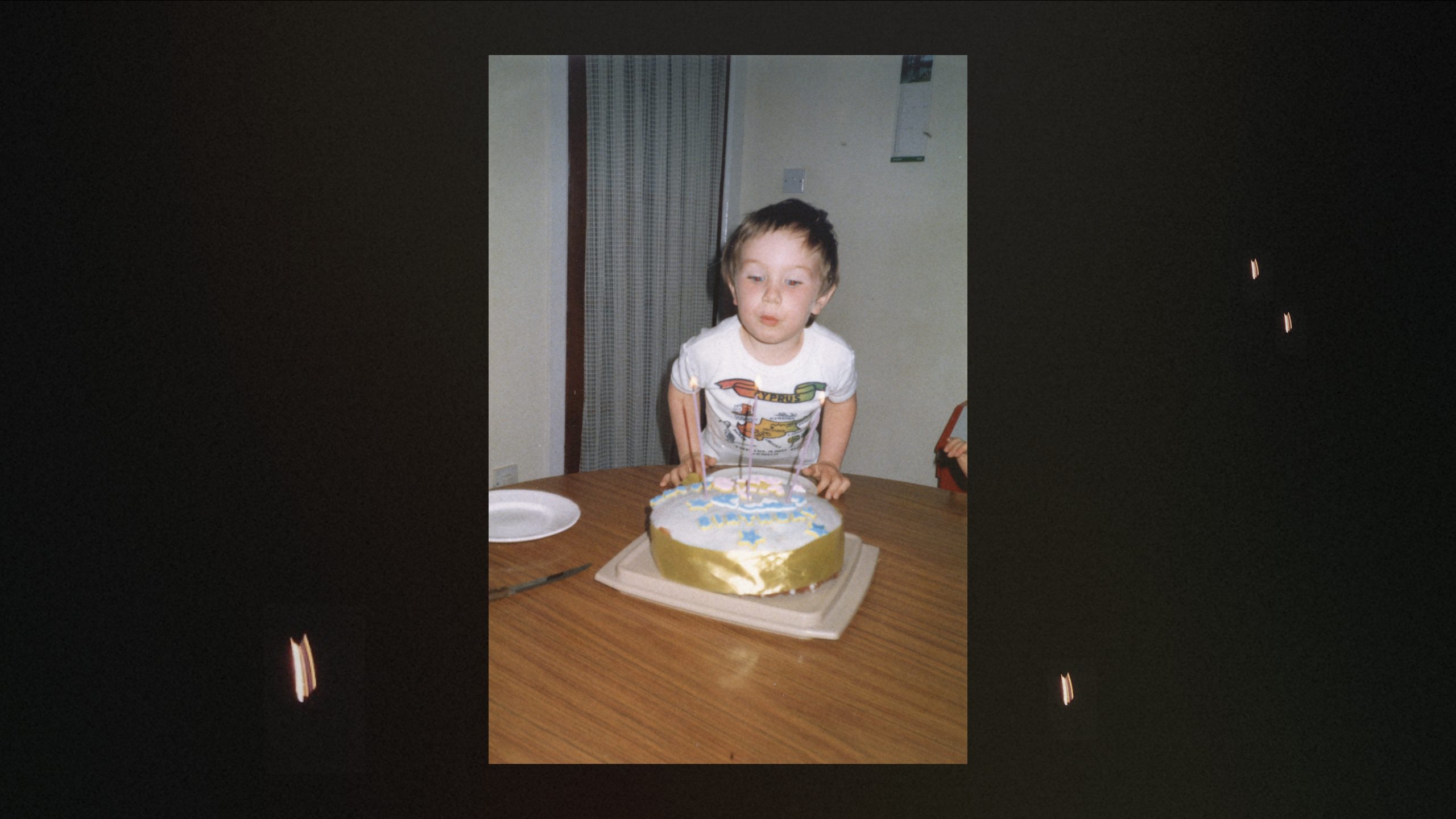
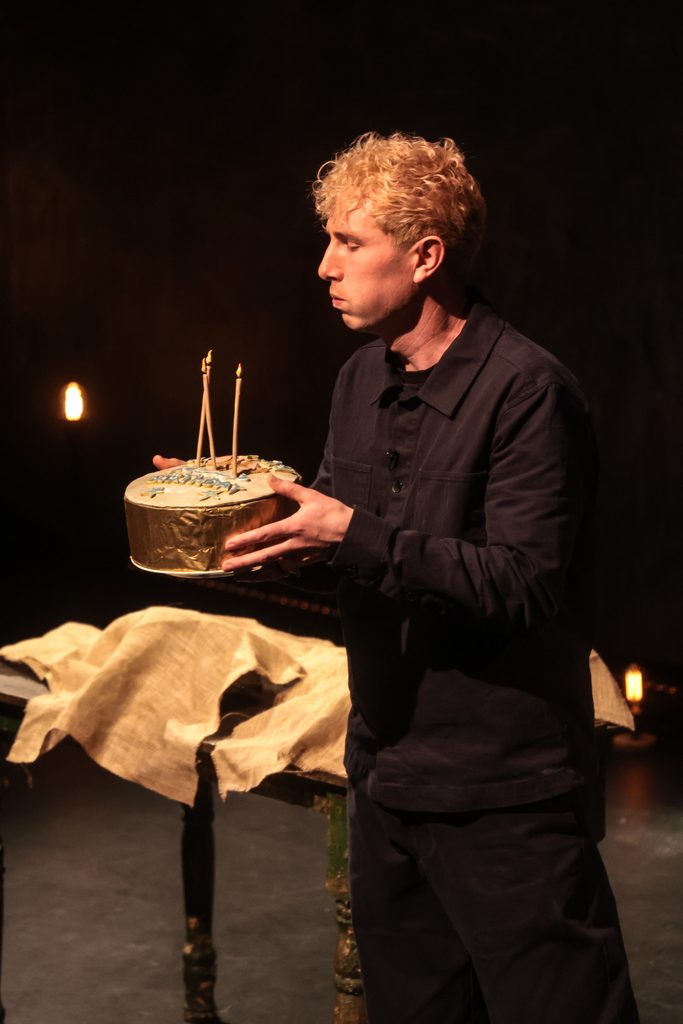
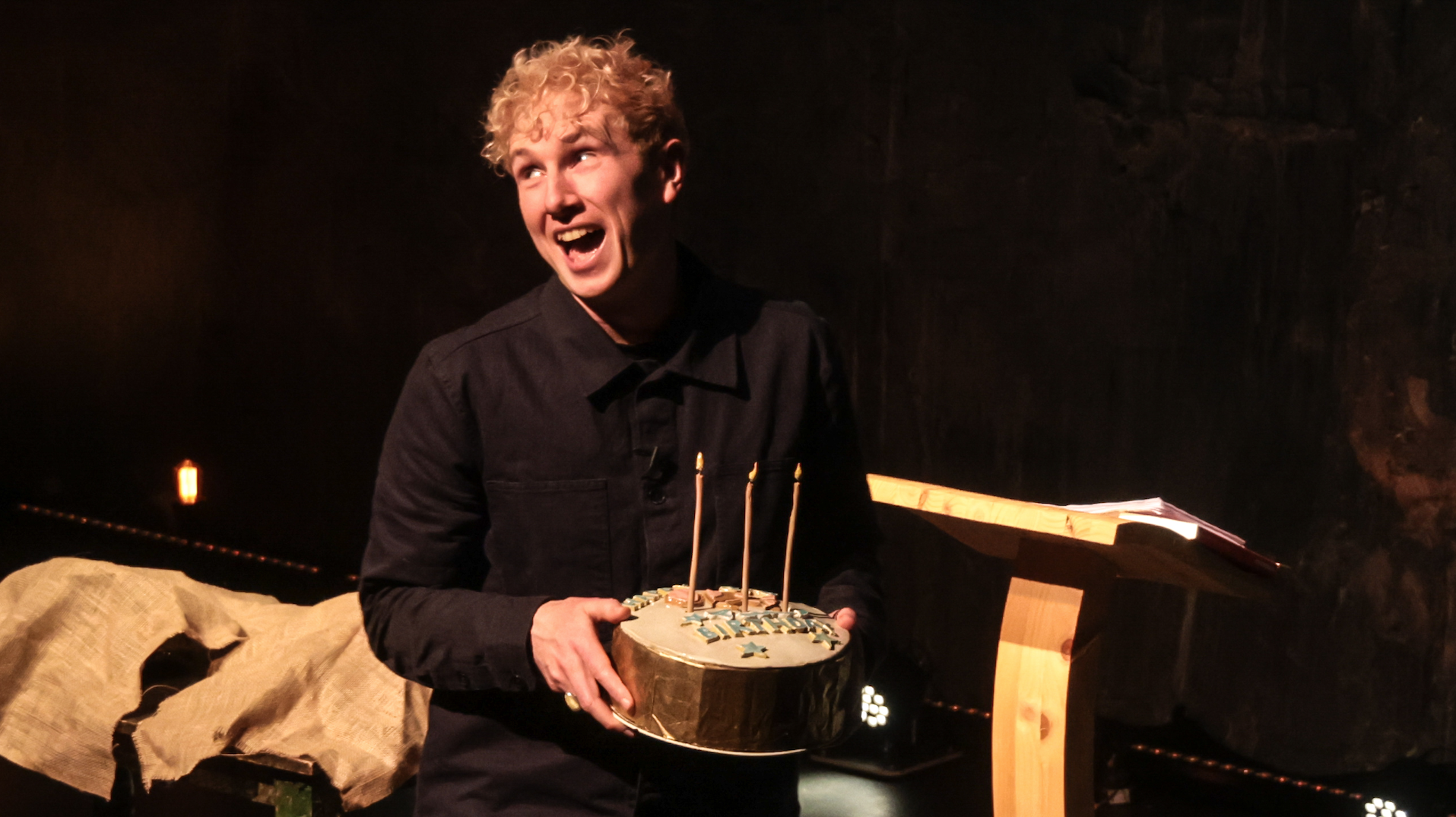
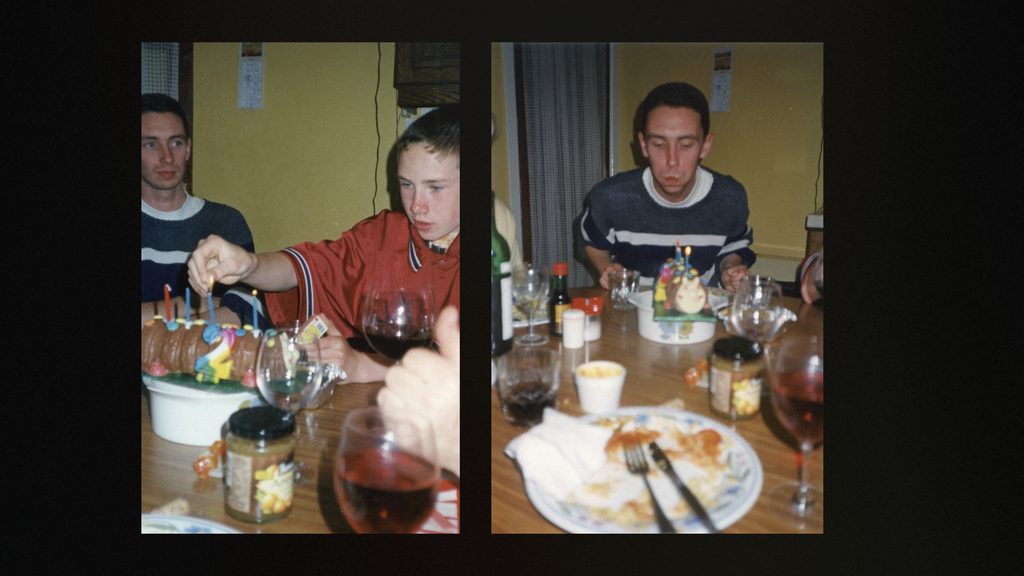
[1] What follows is an abridged text of ‘an intimate, darkly comic essay-performance that reflects on the meanings and functions of fire in life and art.’ Or at least that’s what the blurb says, which I distrust, as I do most blurbs, even though I’ve written this one myself. It begins with me walking out into the audience, holding a ceramic cake and candles, singing ‘Happy Birthday’; it’s unclear to whom, until a photo appears, of three-year old me, blowing out the burning candles.
BRENDAN
[2] My first memory – fire-adjacent, at least – is of my third birthday cake, baked by my auntie. It was the most extraordinary thing I’d seen in my short life: the shock that edible lettering actually exists, but also the surprise that a birthday cake – a gesture of love – might not be entirely homemade. I’m fairly certain it’s not just a memory reconstructed from a photo, because it’s not the candles or fire that I remember. What I actually remember is the moment my auntie pulled the lid off the Tupperware and seeing the cake for the first time.
It is only when trying to remake the cake in ceramic that I realised I’ve no idea what it is supposed to depict. A rhino? A pig? I asked my mam recently to see if she could remember. ‘You must have eaten a few bits off,’ she said, ‘before the photo was taken.’ And the crisp, sophisticated lettering I remember so clearly has blinded me to how badly placed it is – that wonky H hanging over the edge. Maybe the lettering is homemade.
And who else is there? Me, my mam, my auntie. And the small fingers poking into frame might be my brothers. But who else? Memories are slippery; part artefact, part invention, part black hole.
Another early memory: making bangers.
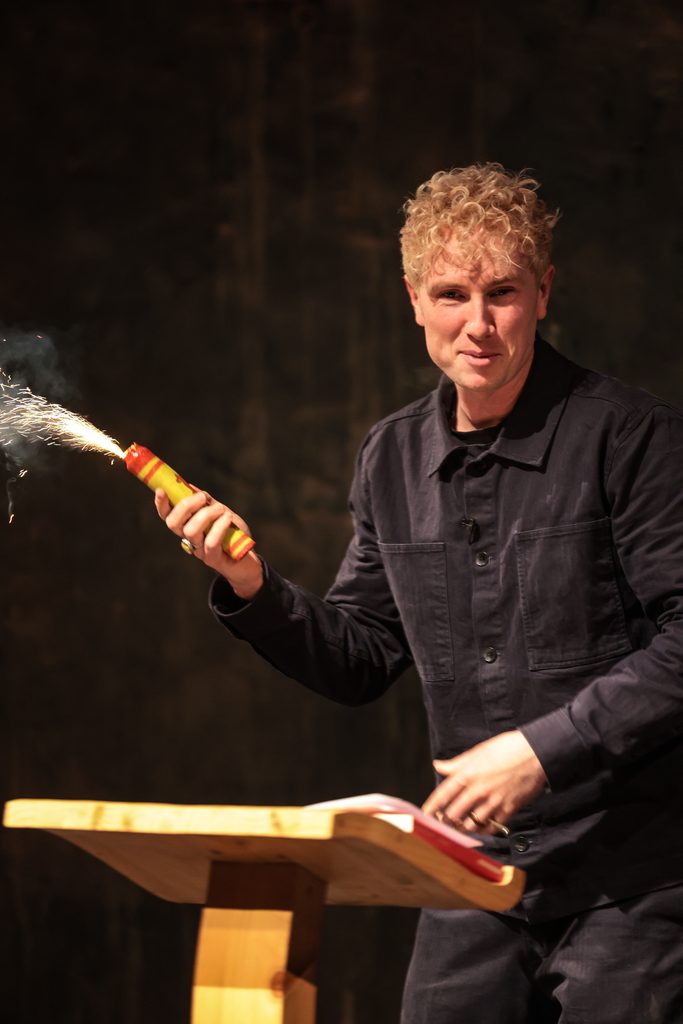
[3] A film shows a close-up of my hands weaving pin bangers which I made as a child. On stage, I walk up to the table filled with ceramic objects, each covered with hessian cloth. I reveal the first item – a replica Sherbet Fountain. I used to buy these as a kid so I could turn the yellow packaging into a quarter stick of dynamite. [4]
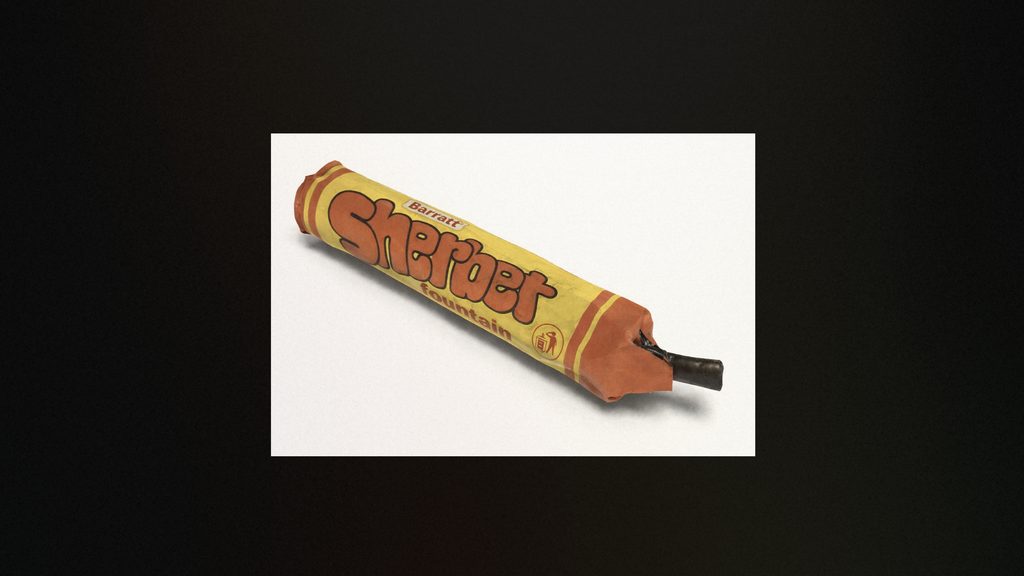
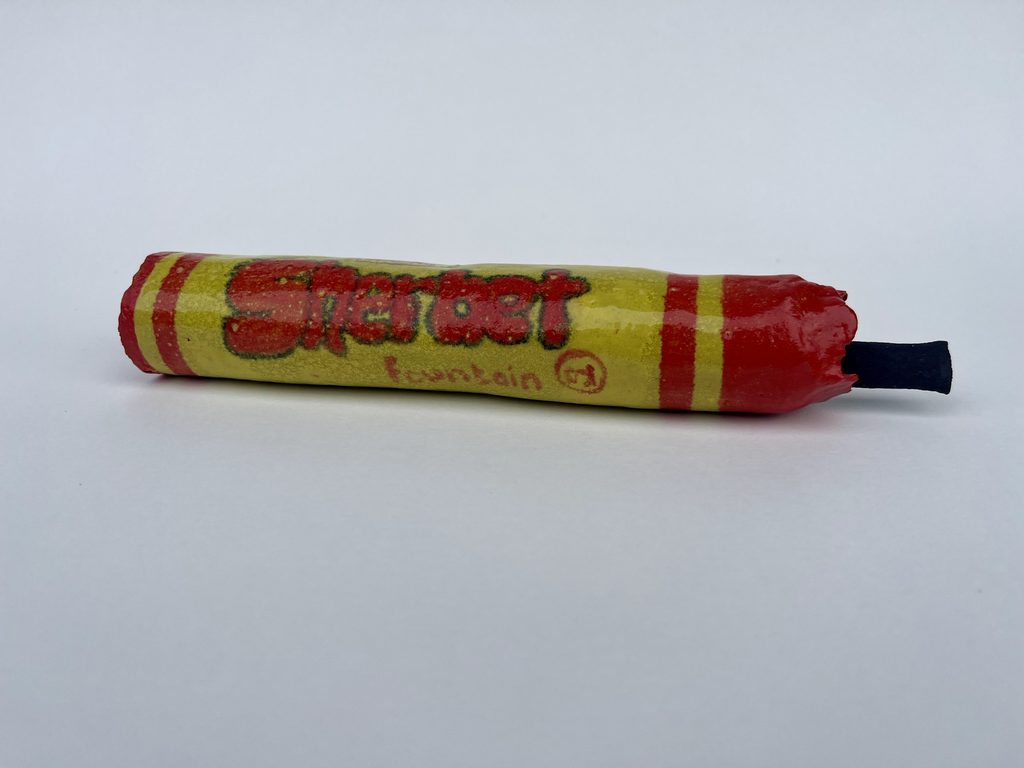
When I grow up, I want to be in the army. To crouch behind burned-out trucks and throw quarter sticks of Sherbet at my enemies.
I light a fuse attached to the ceramic Sherbet and pretend to throw it into the audience.
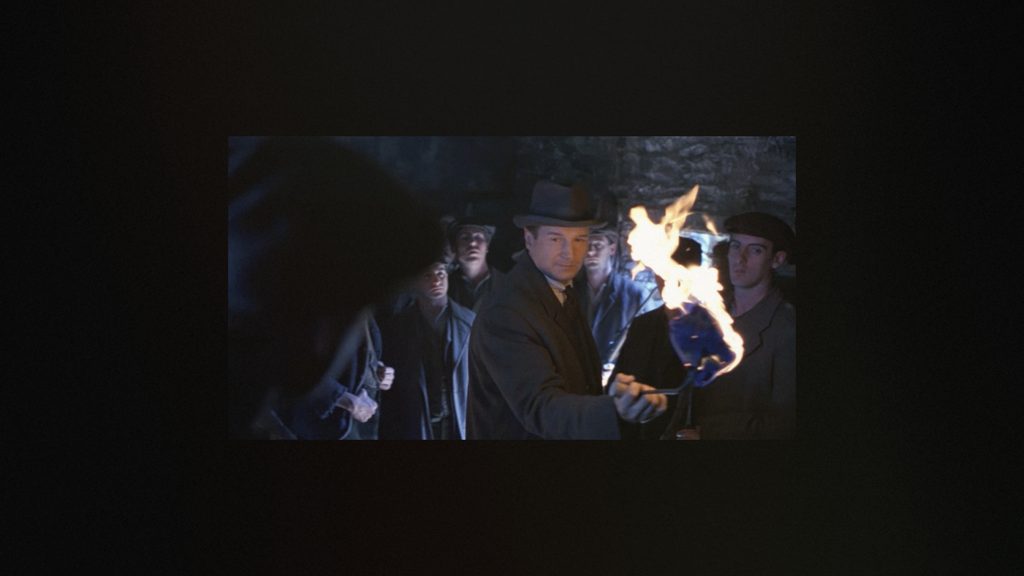
[5] For want of a real quarter stick, a sod of turf is a good alternative. Our first all-family outing to the cinema is to see Michael Collins. Remember that bit – Liam Neeson dipping the sod in oil, setting it alight, then letting it fly over the thatched roof of an RIC barracks.
Aged ten, I bus into town with my friend Ronan Harte to buy fireworks. Ronan and I have known each other since playschool. I’ve converted him – or coerced him – into helping with my latest pyro plan. On the green, up the road from my house, we break open a whole pack of Black Cats, tear all ten in half, and pour out the flash powder. I strike a match and the powder flashes orange-white, violently, into my face, singeing my eyebrows and leaving my thumb with second-degree burns. Melted, basically. What does Ronan do? It might be fair to say that Ronan is not my only friend. However, I might be his. And yet, he’s clearly in too deep. He legs it. I’m left hanging around the green for hours, presuming this will be the end of my fireworks career. But when my mam finally finds out, I get the full Sudocrem and Calpol treatment.
The power and pain of fire has dawned on me. But have I learned my lesson? Absolutely not. By now I have developed enough of a reputation – among my family at least – that nobody else lights the birthday candles.
In the live show, there is more historical ‘evidence’ of my pyromania: lighting birthday cakes at home, lighting fires in homemade igloos and my matchbox collection. [6]
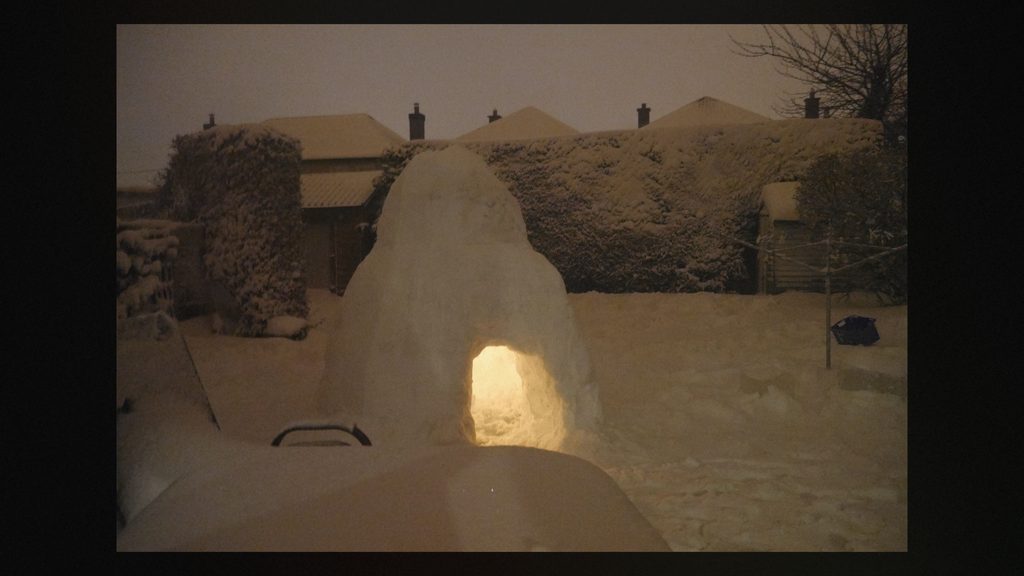
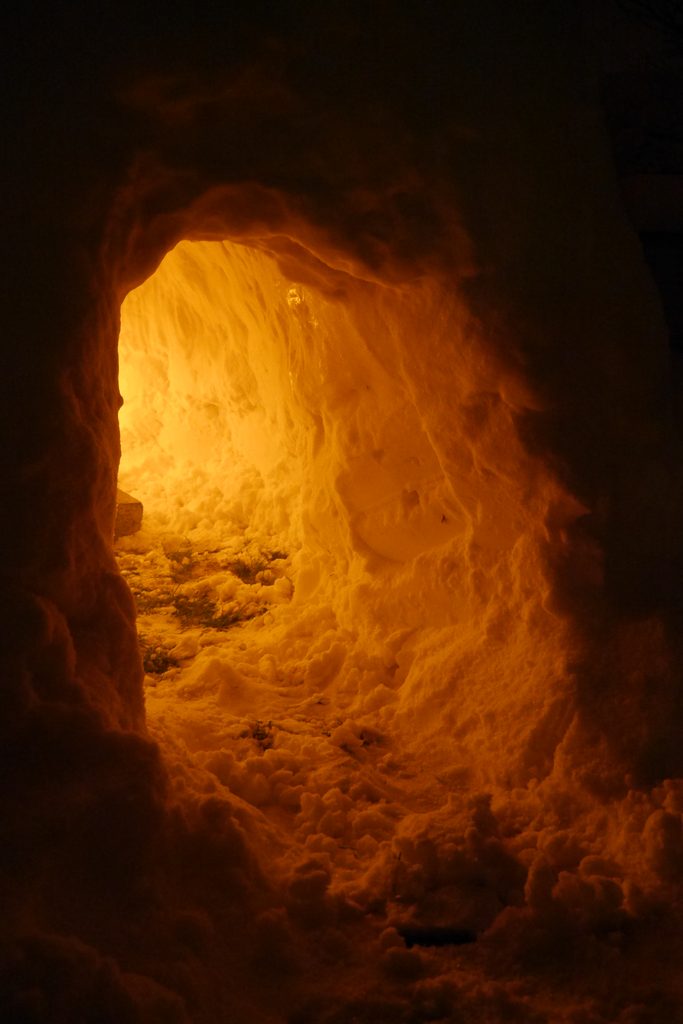
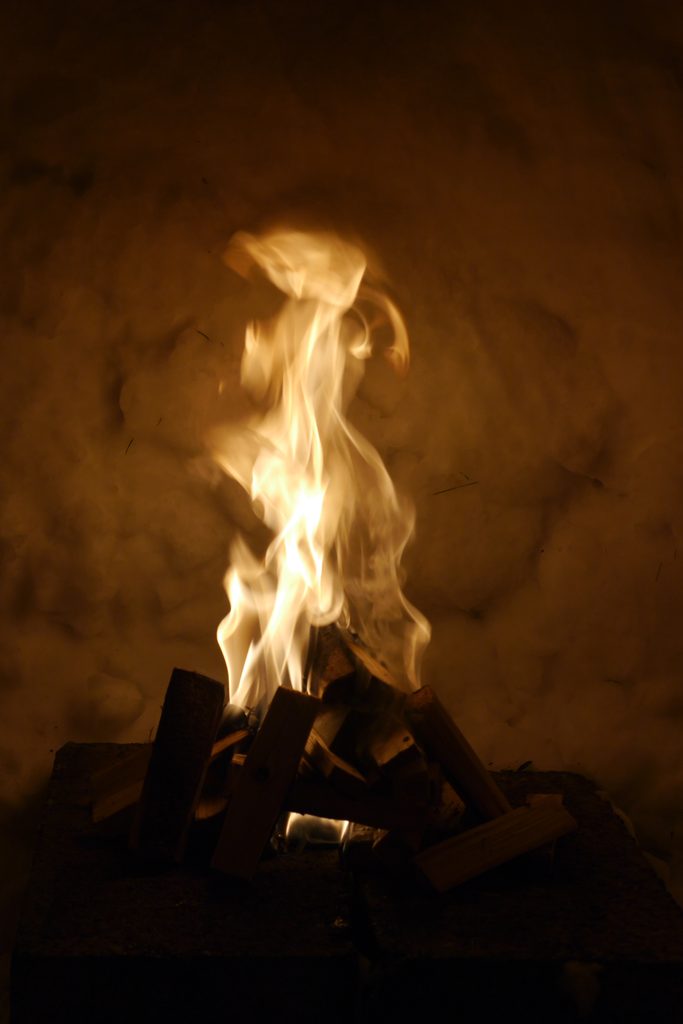
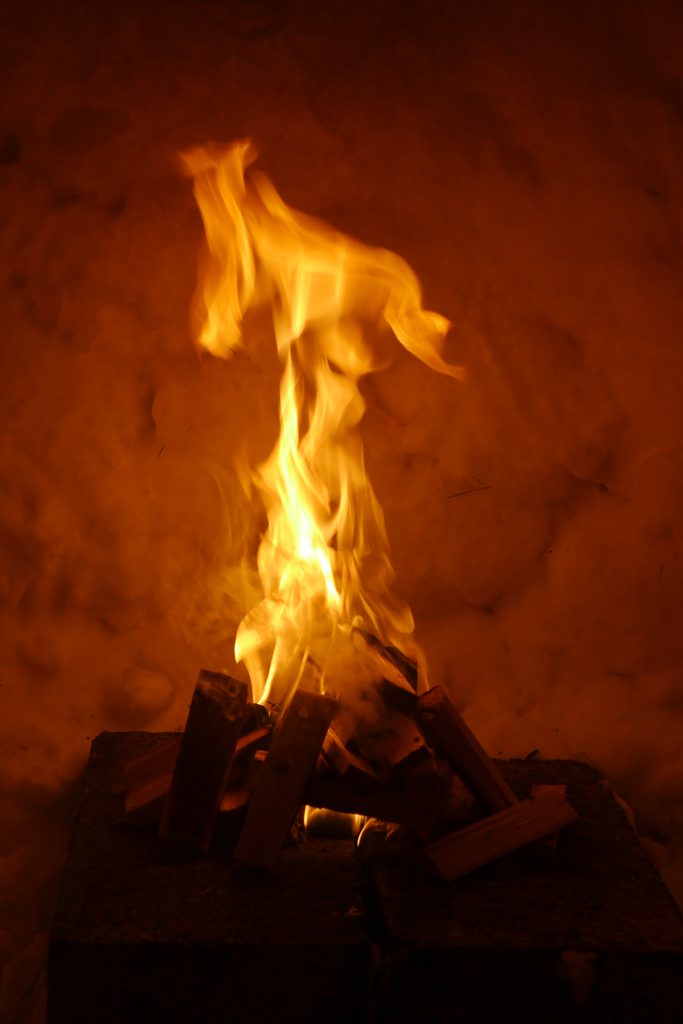
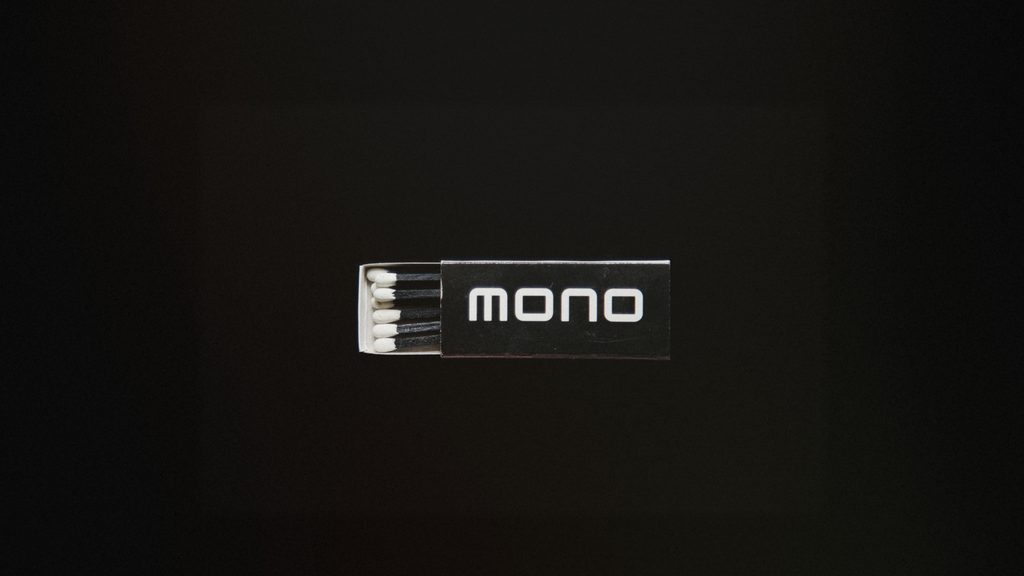
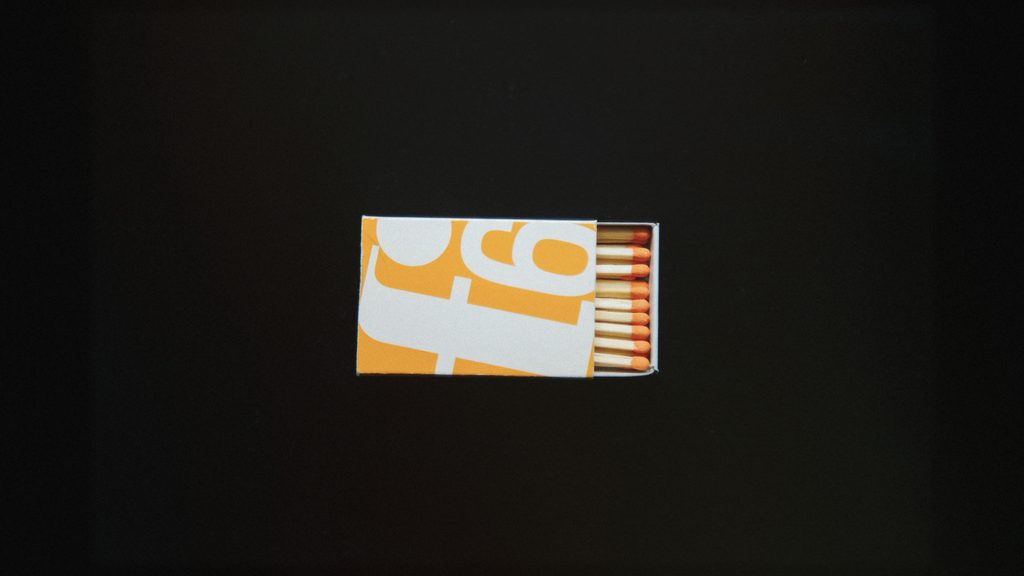
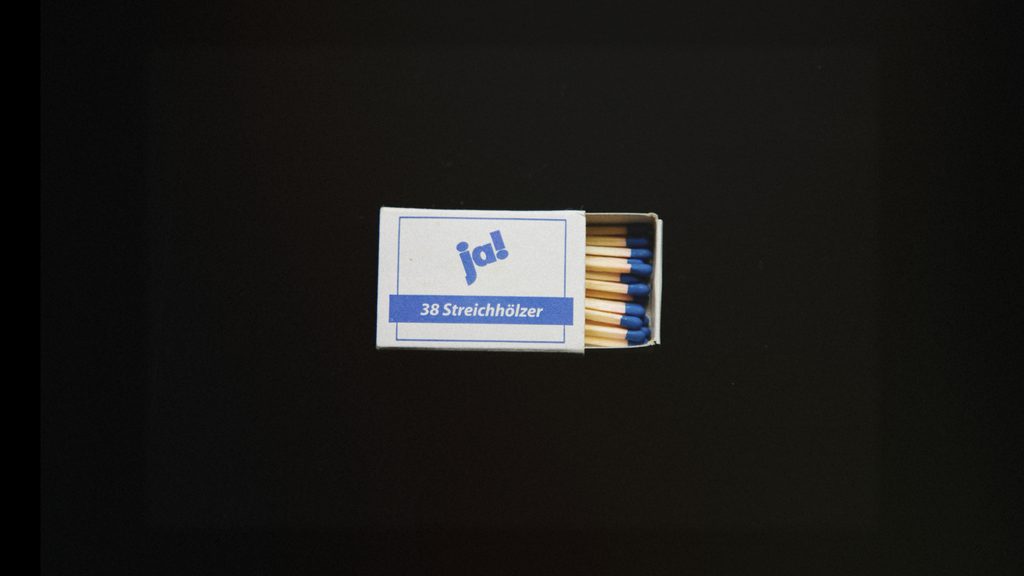
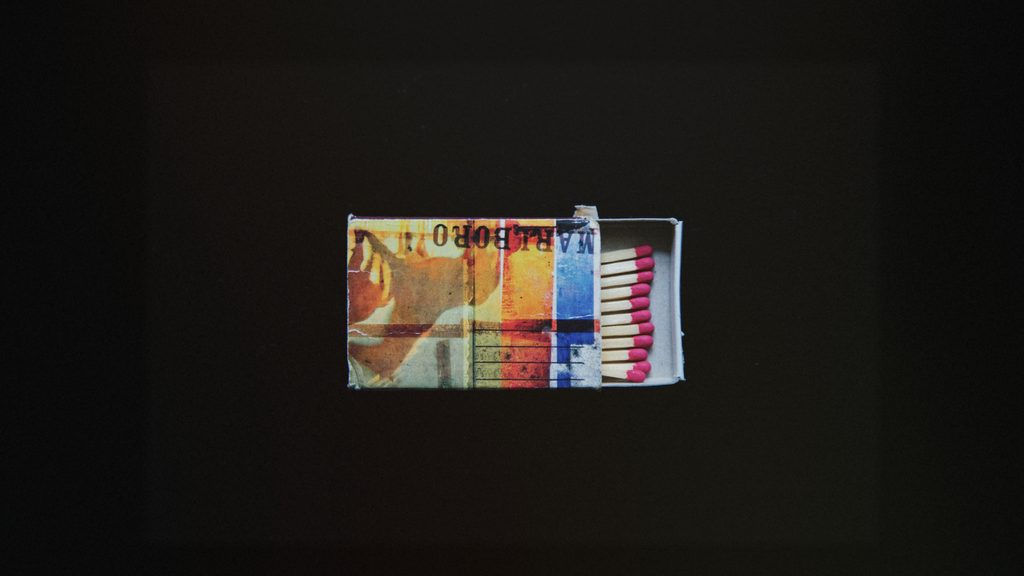
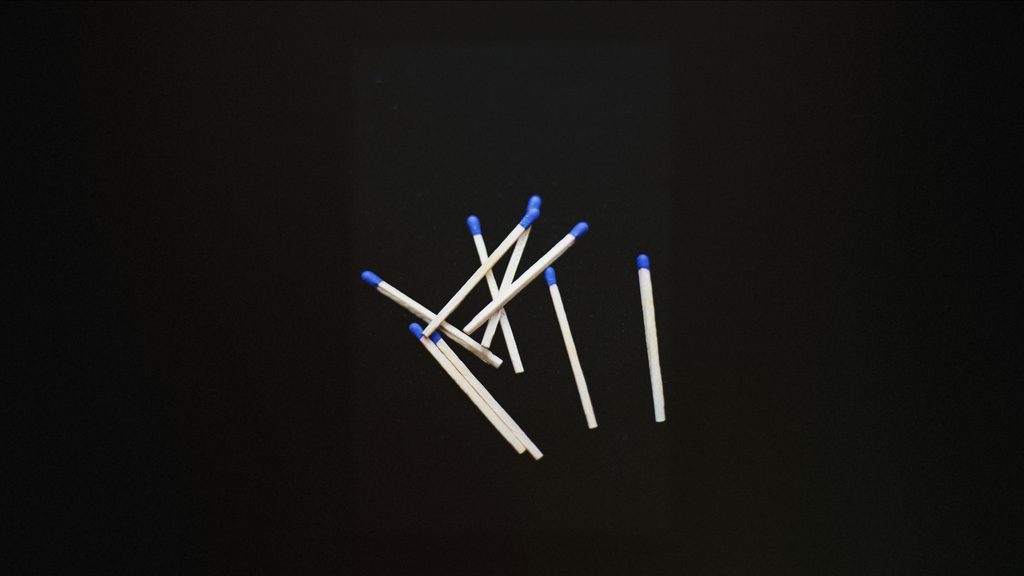
Clinically, pyromania is seen as an impulse-control disorder. It’s an intense fascination with fire and fire-setting paraphernalia that gives pleasure, relief or emotional release. Gaston Bachelard, in The Psychoanalysis of Fire, says that ‘the initial seduction is so compelling that it deforms the most rational minds and leads them to the cradle of poetry, where daydreams replace thought’. I suppose I just love fire. But I think we’re all drawn to it. To light a fire somewhere, anywhere, is to make that place yours, to call it home, if only for a while. But that’s not its only function. At the right temperature, fire in a kiln performs a kind of alchemy, hardening clay into objects that can survive for more than twenty thousand years. Ceramics is the process by which we morph the ephemeral objects of imagination into solid, permanent reality.
Fire helps us to remember. Through ritual burnings or the lighting of a candle in a church. And fire helps us to forget – a lesson I teach my daughter when the time comes for her to say goodbye to her dodos.
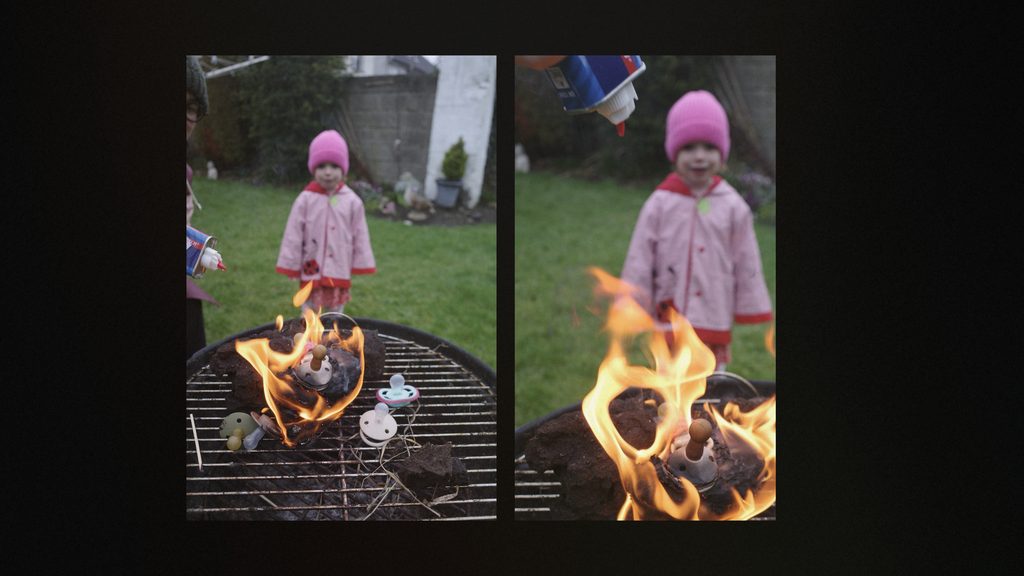
[7] A photo of my daughter in our garden. Between her and the camera is a barbeque with dodos piled on the grill in flames. She consented!
Fire, in this way, helps us transition. Helps us to move on.
I throw a fun snap on the ground. A fiery dinkus appears on screen.
*
April 2018. I am lying awake in bed with a new idea for a short story. At half one in the morning, I turn on the bedside lamp to get it down on paper. A woman travels from Dublin to Kerry. Her name is Martha. She moves in to the cottage of a professional artist who encourages her to become an artist too. He helps her to uncover her obsession – fire, of course – and he lends her his good camera. The notes are in the first person. The novel is too, initially. Martha was, to quote my diary, ‘going to offer a unique service of setting people’s precious, most meaningful belongings on fire, photograph the burnings, and sell the photos for a grand a piece.’ Optimistic to say the least. The notes run to six pages. What I have on my hands, I realise, is something longer.
Among the objects people bring to Martha are: an old electric fire, which I note, ‘was pure meta-gold’. This does not make the cut. The body of a greyhound is also brought for burning, or cremation, from a Tipperary undertaker: also cut. But I’m surprised by how much does survive, seven years later, in the published novel. One image in particular: of an object floating on a wooden pallet. It becomes part of Martha’s first ‘big idea’.
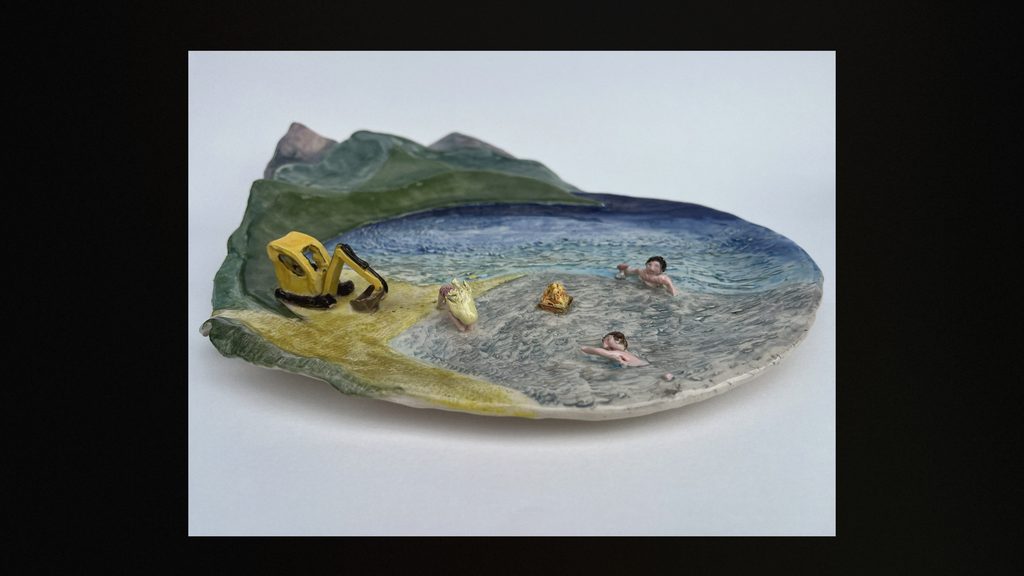
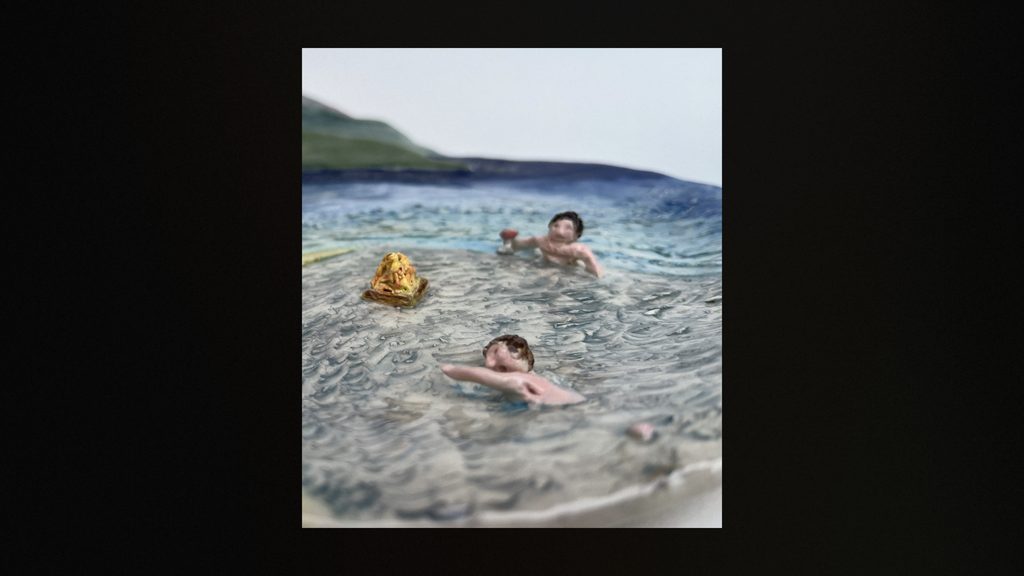
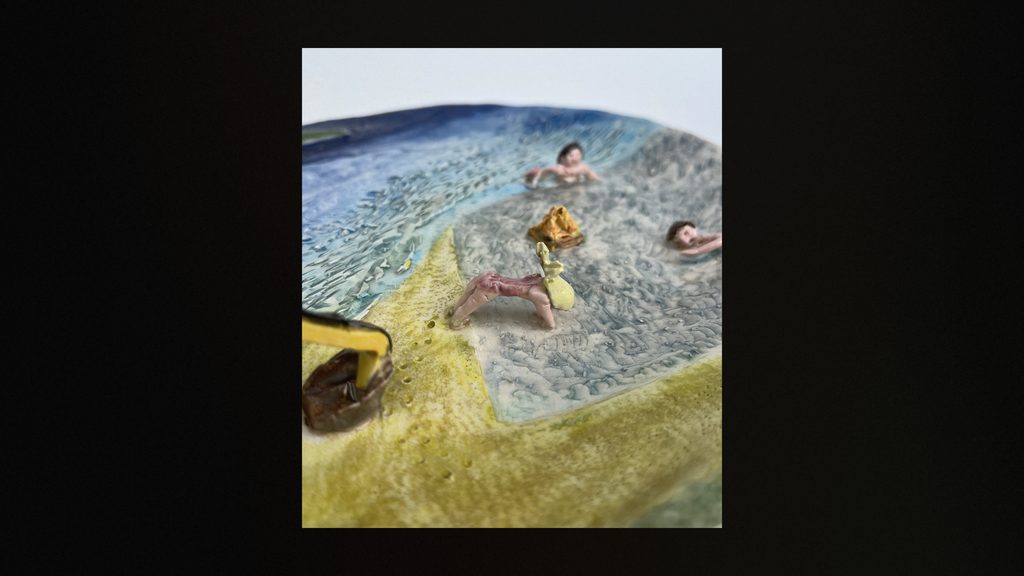
[8] A photo appears of a ceramic plate depicting the scene below – of a swimming pool dug into a beach in West Kerry. I pick up a copy of my novel, Deep Burn, as if to read. Instead, a woman’s voice begins to read over the PA.
MARTHA
‘In my head,’ she tells Billie, ‘there are three teenagers in shot. Two boys and a girl. One of the boys is sipping a cocktail, his elbows resting on the pool edge, the water lapping at his chest. The other is swimming lengths. And then the girl – she’s not actually in the pool, she’s standing above the boys, ready to dive in. All three are ignoring this big fire floating at its centre.’
Martha was ashamed to admit that it didn’t mean a thing, though she wanted it to. In her mind’s eye, there was definitely something important burning on the pallet – but it was as if the flame’s light was obscuring her view.
BRENDAN
Martha struggles to find a suitably significant object to burn. In the end, her choice – a police uniform – is transposed from my own family history.
*
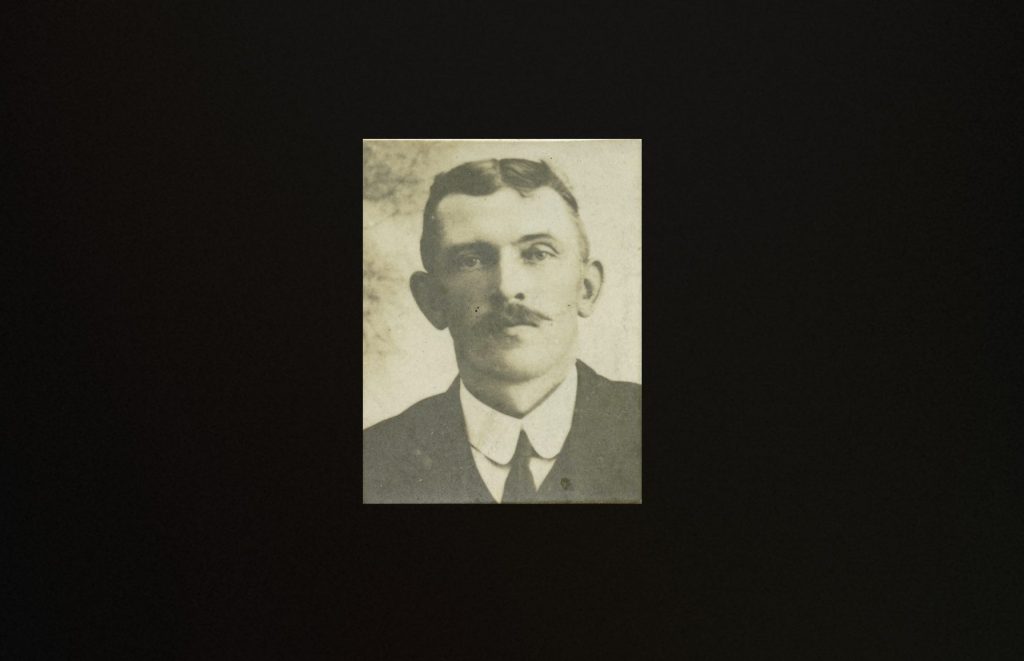
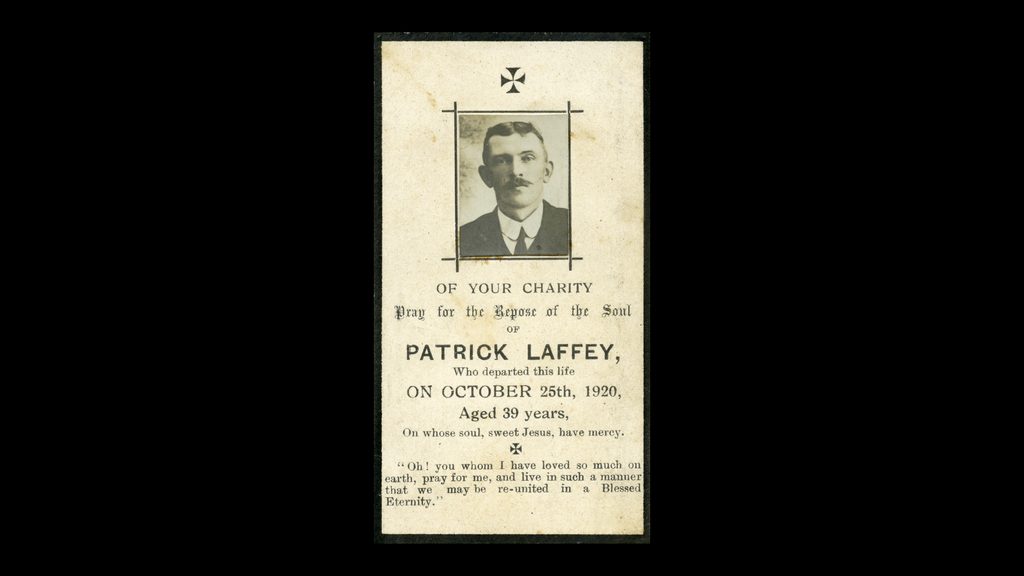
[9] My great-grandfather, Patrick Laffey, a Galway man, who by the year 1920 is my age – 41 – and is living in a thatched cottage in Sligo with his wife and five children. He is a member of the Royal Irish Constabulary, who act as both local police and military arm of British rule in Ireland. In 1920, during the War of Independence, the first elected Dáil declares a boycott of the RIC, who are refused service in shops and pubs. Many are shamed into resigning their positions. Barracks are abandoned or fortified in response to an increasing number of Liam Neeson-style attacks. In October the same year, in the townland of Moneygold, Sligo, a large contingent of IRA men lie in wait for the arrival of an RIC patrol. [10]
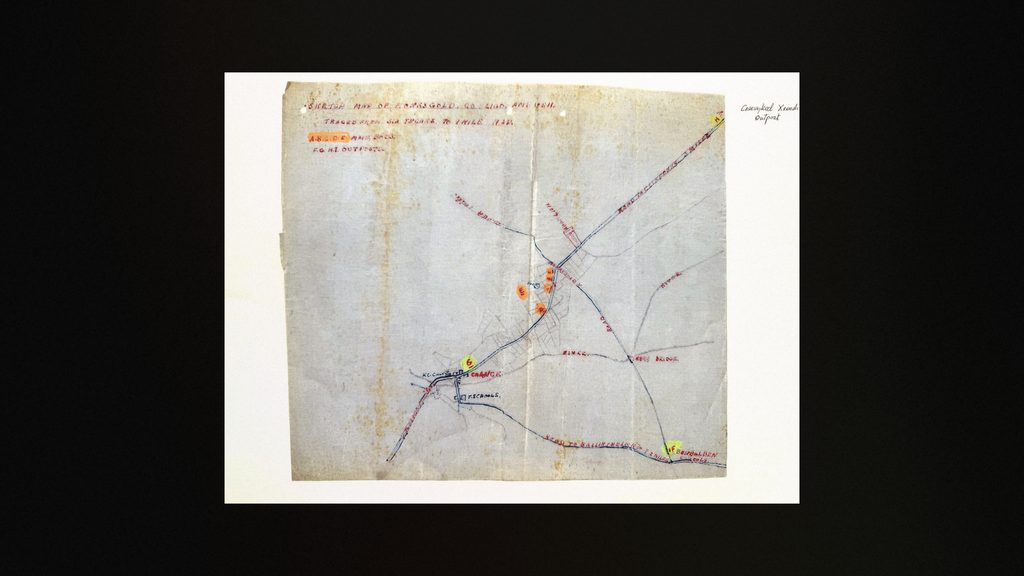
The IRA have cut the shafts of a cart belonging to a local man, who in turn alerts the police. Nine RIC men set off from the barracks, on their bikes, to inspect. Patrick Laffey is among them. The IRA call on the RIC to surrender, but the sergeant draws his weapon. (This is one version. The other being that they were out to kill the sergeant regardless.) A fifteen-minute gun battle follows. Constable Laffey is shot and killed, the bullet entering his neck and lodging in his brain. Three other RIC men including the sergeant are killed.
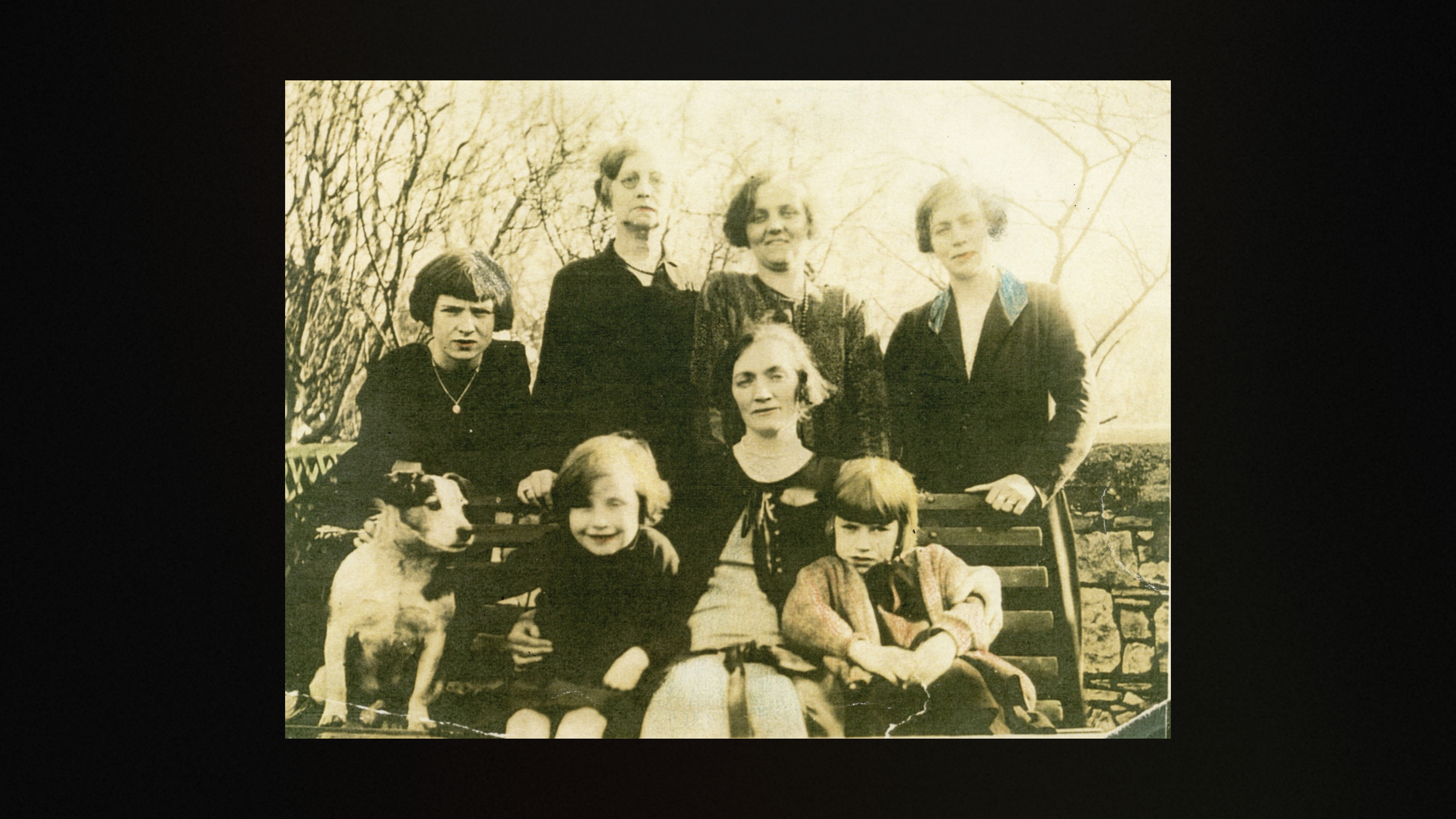
[11] Still under boycott, my great-grandmother, Patrick’s widow, is forced to move. With the compensation from her husband’s death – £7,500, an enormous sum – they move to Clontarf in Dublin. They buy a large house on Saint Lawrence Road, take lodgers and open a newsagent on the seafront. [12]
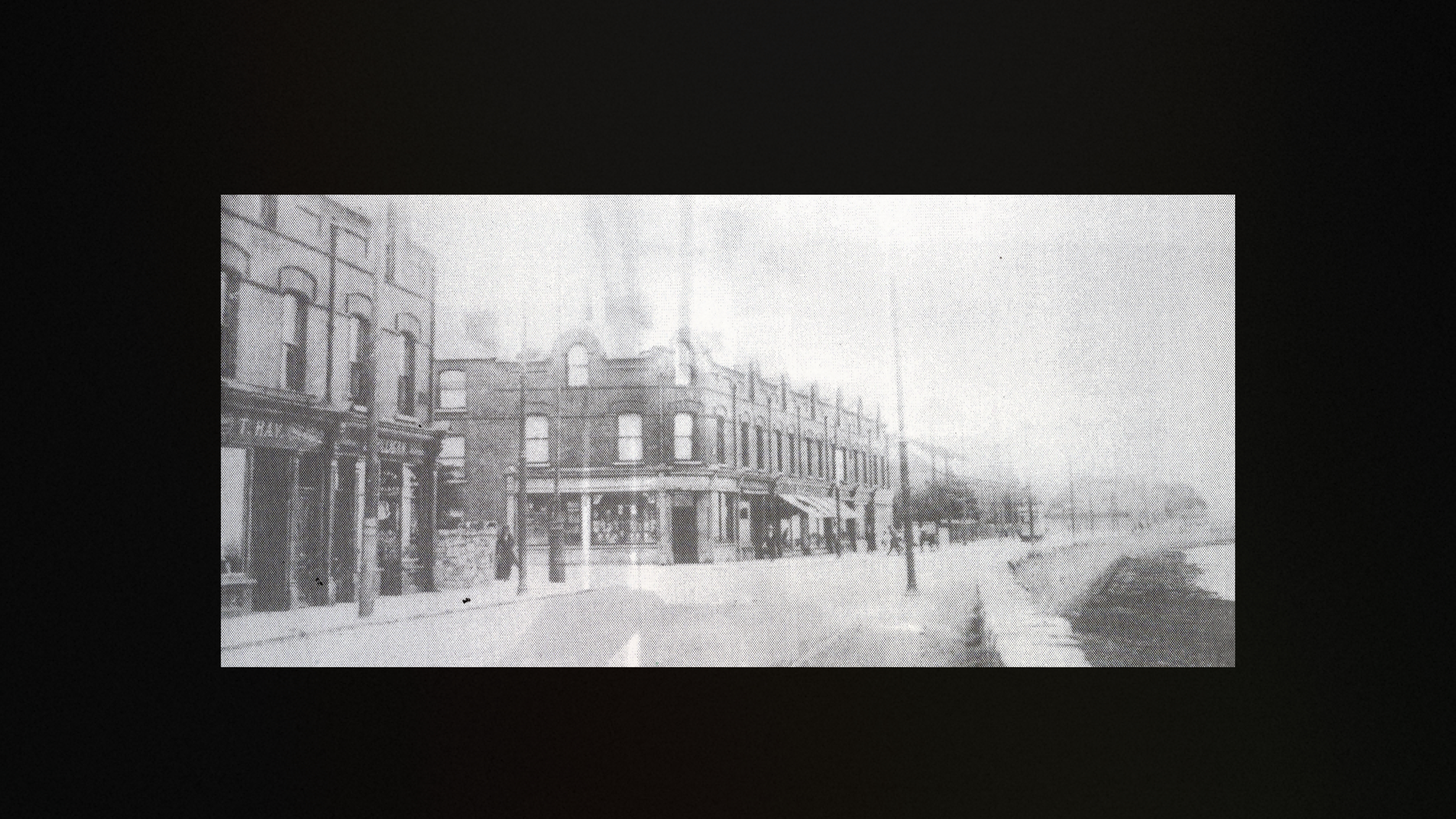
The house stays in the family for years, becomes multigenerational. My mother is born there in 1944; the house becomes her childhood home. She remembers playing shop in the house with her younger brother, Martin. They used WWII ration stubs from the newsagent as pretend money for their games. [13]
The other side of the family is a different story.
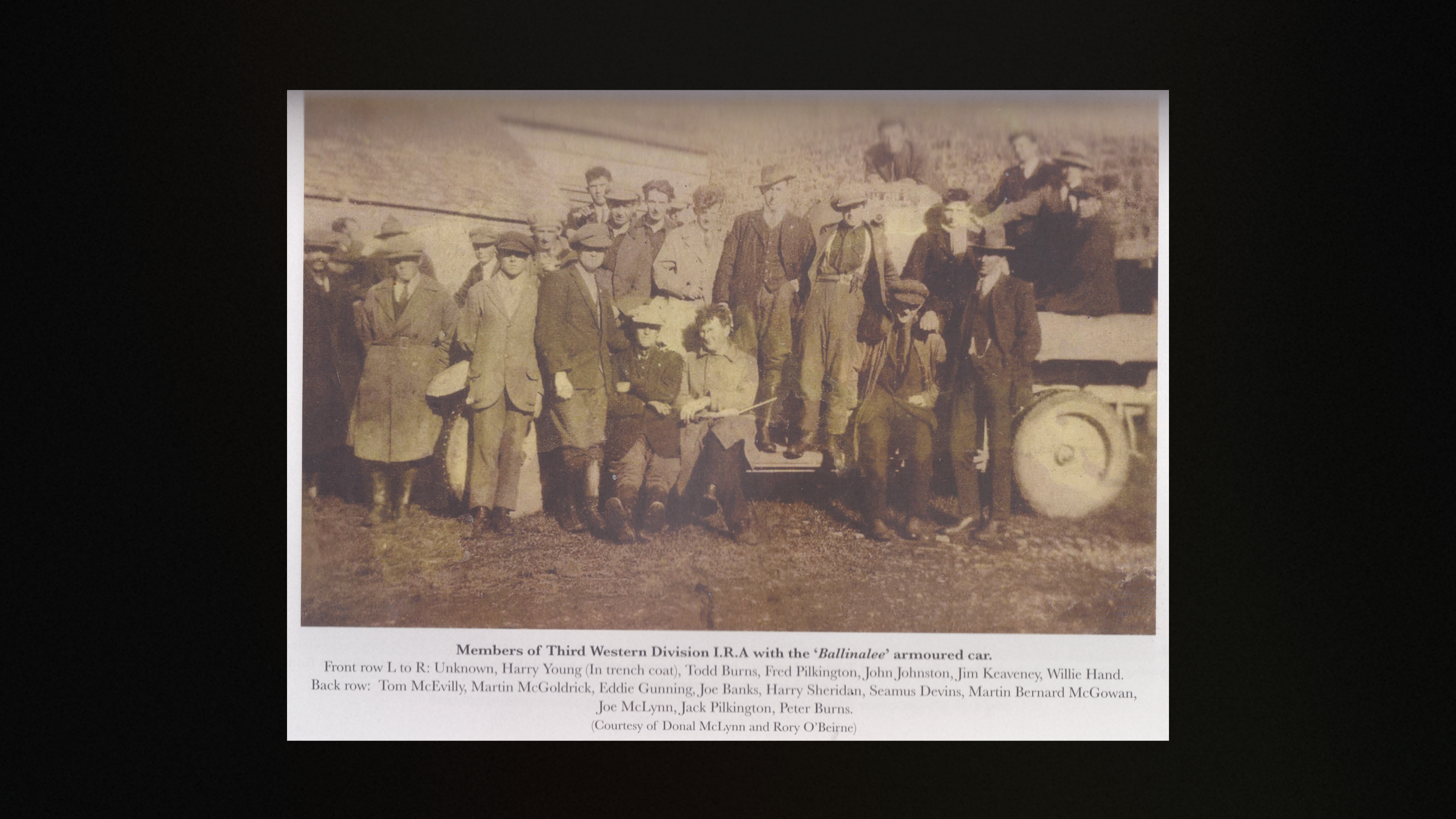
[14] During his time in the IRA, my grandfather, Tom MacEvilly (my dad’s dad), moved from Mayo to Sligo, where he quickly became adjutant of the Sligo Town Battalion. I remember in my teens, after learning about my mam’s family history for the first time, that my dad began to research the possibility that his father had been present at the Moneygold Ambush. That is, that my IRA granddad might have shot and killed my RIC great-granddad.
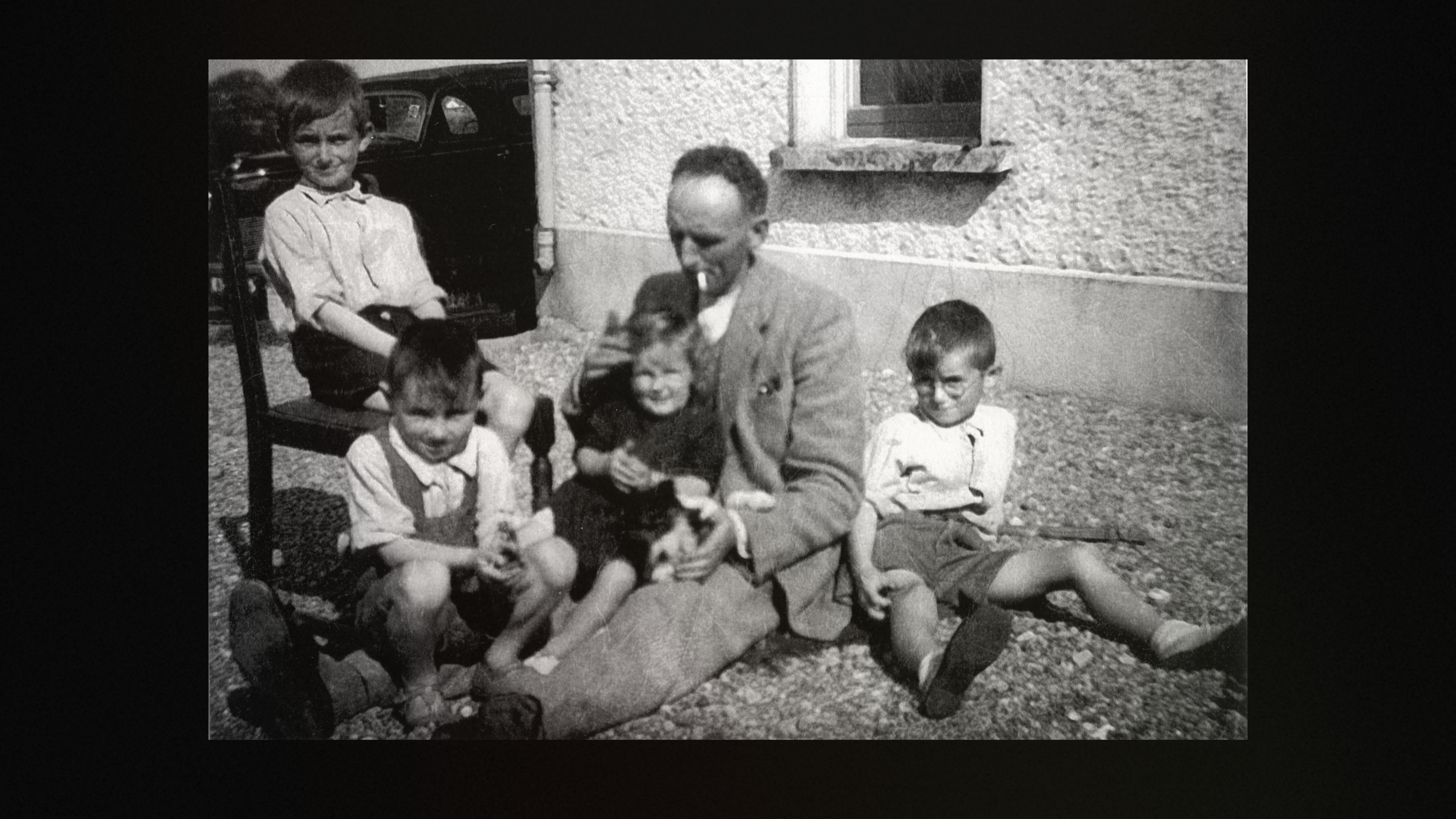
[15] As a child, it’s my dad’s family history we hear all about. The heroic side. The right side. About prison time and jail breaks, beatings from prison guards that left him deaf in one ear, and a commuted death sentence. If Dad’s father had killed Nana’s father, what would they do? I remember Mam and Dad talking about it. Should they tell Nana, still alive at the time, who was only two years old when her father was killed? And if so, what would be the good of knowing?
*
Roll on a century from the revolutionary period and during Covid, my mam adds what seems like a subplot – but turns out to be the main story. We’re sitting in the living room with my dad. Mam begins to recall a memory. She is a teenager – sixteen or so. She is at the kitchen window of the house on Saint Lawrence Road, looking into the garden as her mother – my nana – is pouring oil over a uniform. A pit has been dug. The uniform is in it. It is on fire.
She doesn’t understand what’s happening at the time, she tells us. She’s always had her head in the clouds – a trait she says I’ve inherited. ‘The absent-minded professor’, she used call me. But her brother Martin is beside her and he explains it: the uniform belongs to their grandfather. The one he was wearing when he was shot and killed in Sligo. All his effects – the uniform, even a revolver – have been hidden for decades in a large steel trunk in a cupboard upstairs. They are warned ‘under pain of death’ never to touch it. Now Nana is in the garden, burning it. The uniform of a man she couldn’t possibly recall, being only two when he was killed.
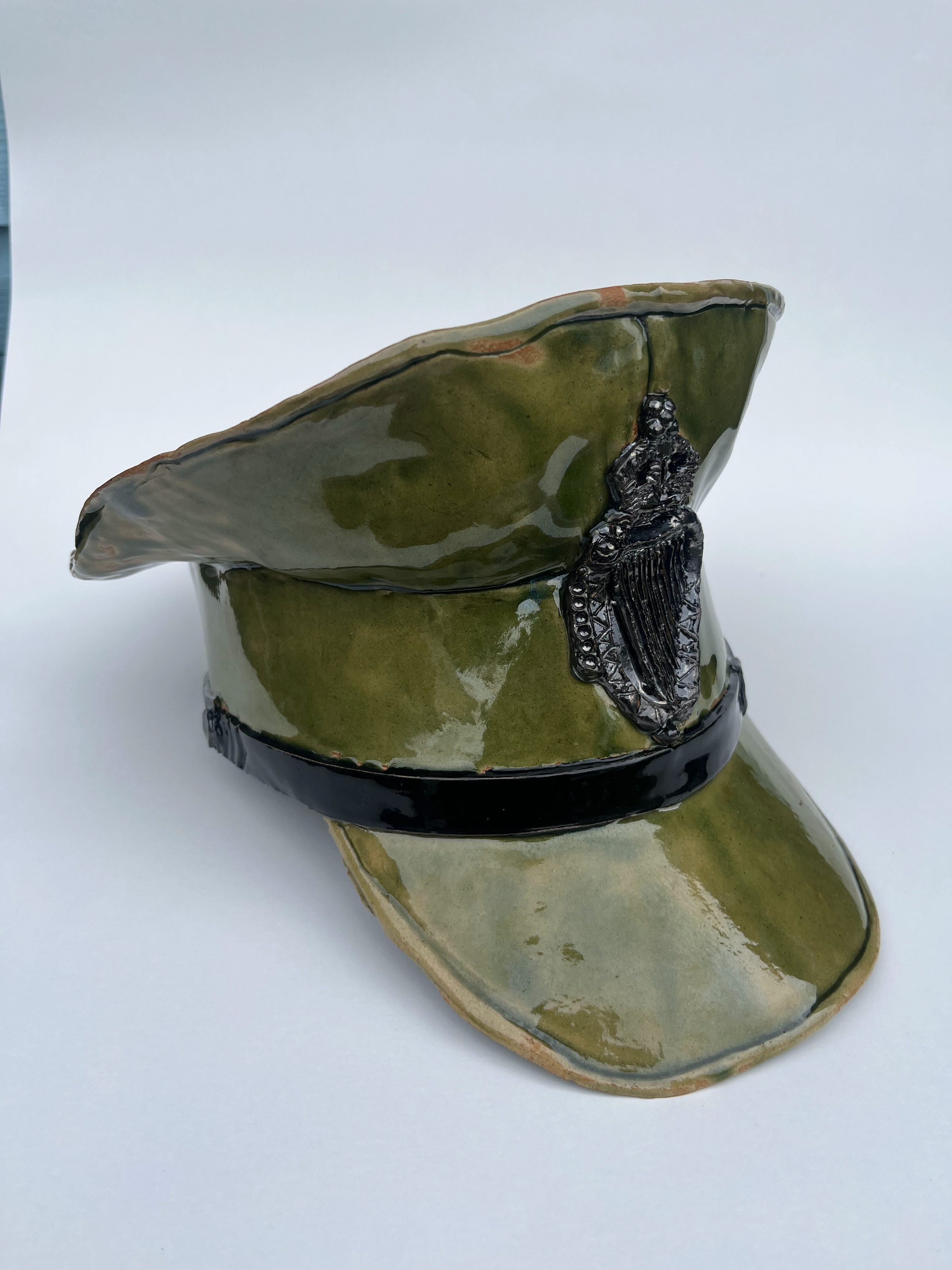
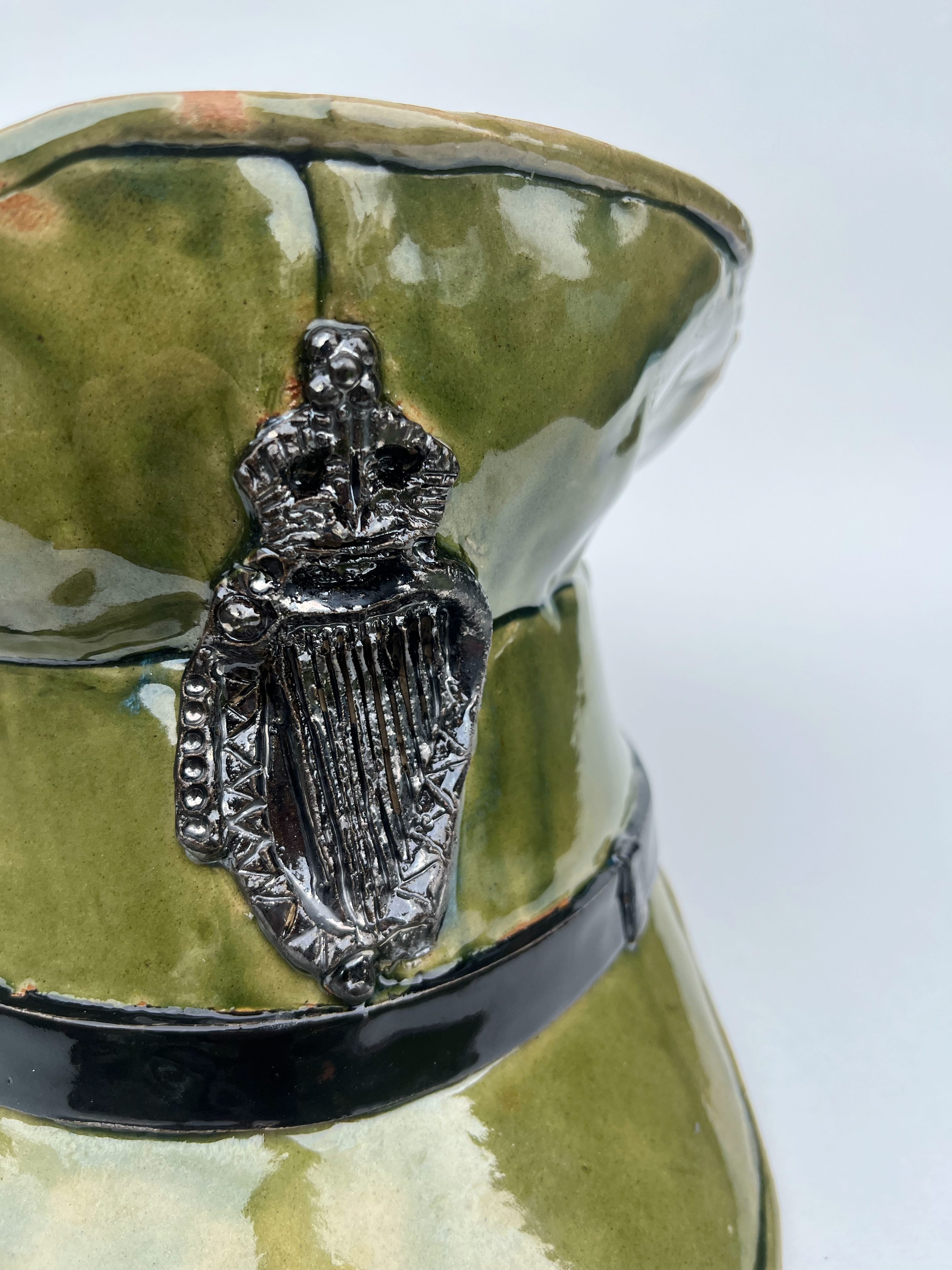
[16] I reveal a ceramic, life-sized replica of the uniform’s hat. Later I reveal a ceramic Webley revolver. Even before I’d made them, I knew I wanted to film them as they burned, or better yet, exploded. My solution was to travel across the border to Newry, buy a tonne of fireworks and pull them apart to collect the flash powder. I then filled the crevices and orifices of these and other ceramics with the powder, attached fuses, lit them and hit record. It’s the best evidence I have that art is play. [17]
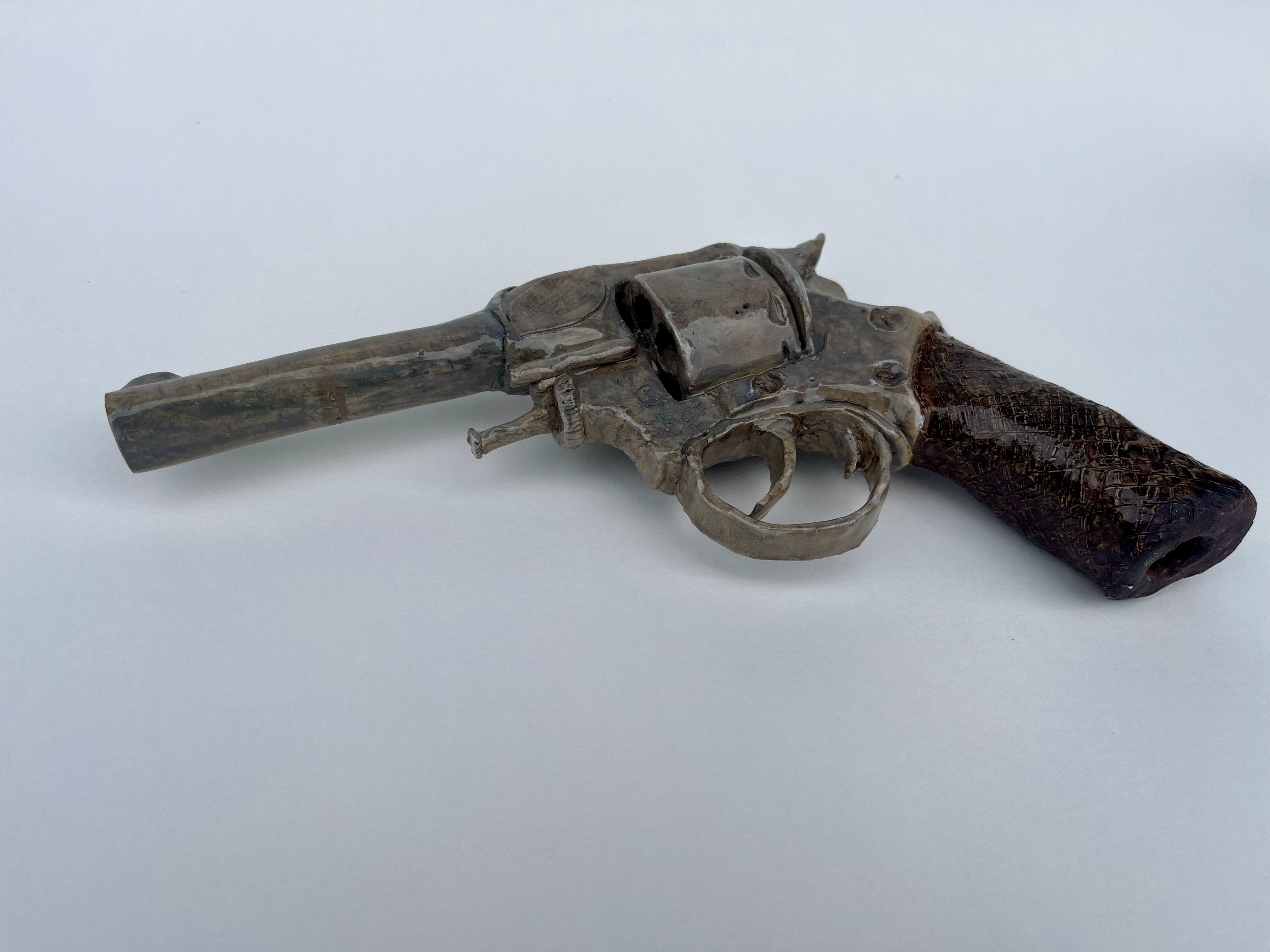
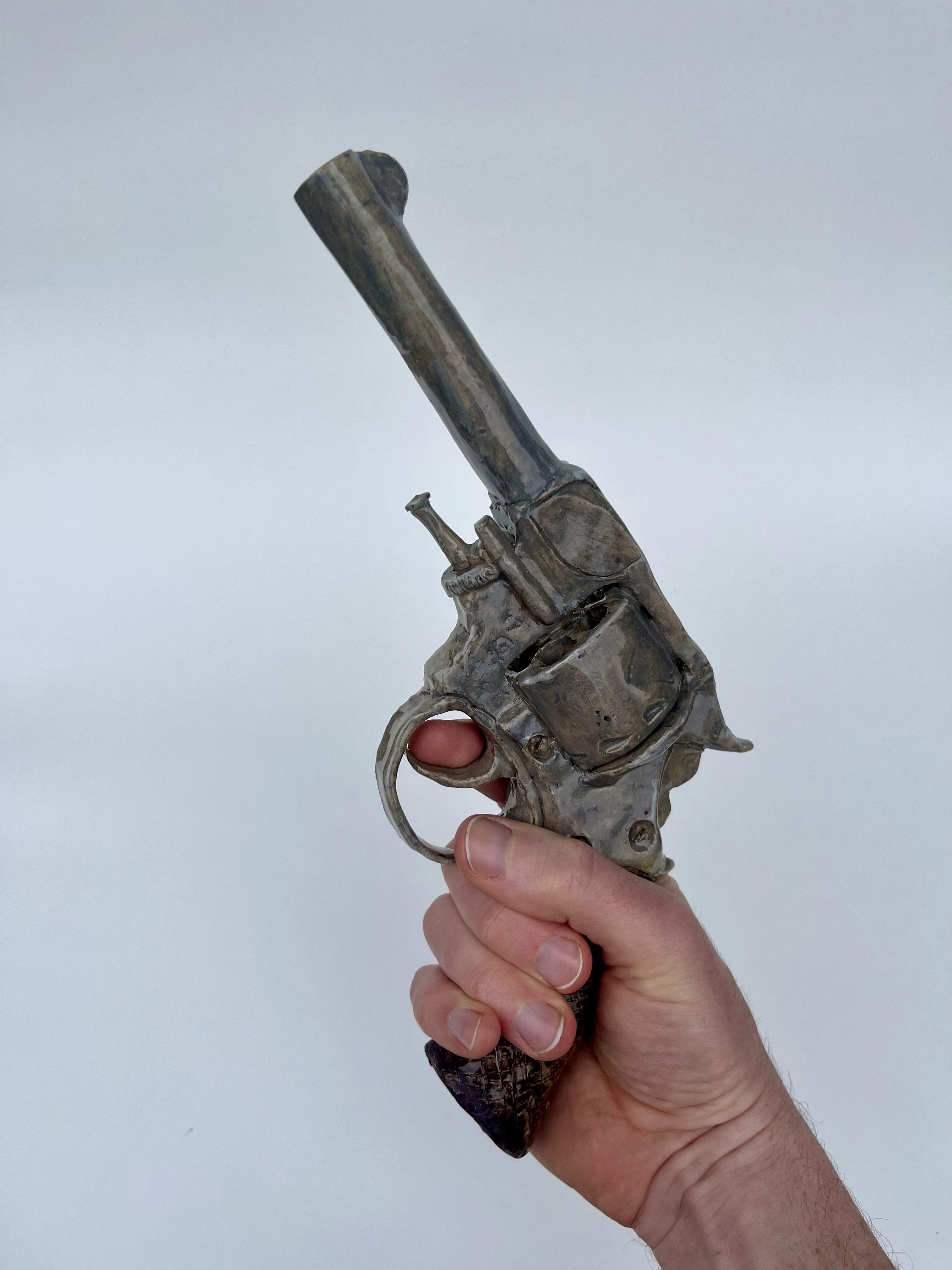
I place this event in the mid-1960s, around the fiftieth anniversary of the Easter Rising. Perhaps the moment carried a charge – stirring shame, a need for secrecy – for those caught on the wrong side of history. In Deep Burn, the backstory of this uniform is given to Sal, one of Martha’s neighbours, based partly on my nana in her later years. In the novel, the uniform survives – the hat, too, and the revolver – passed down to Sal in a wooden trunk in her cottage by the sea in West Kerry. Here is Martha, in Sal’s kitchen, looking for the right object to place on her floating pallet.
MARTHA
‘I need something to burn,’ Martha told Sal. ‘Something with a bit of . . .’ She was about to say ‘emotional weight’ but settled for ‘historical’. ‘I’d like to turn the object, with all its weight, from the awful thing it was into something good. Something beautiful.’
Instead of a yes or no, Sal inhaled a sizable breath. It was as if she’d been lying on her back on the kitchen floor with the trunk on her chest, and Martha had burst in through the door to heave it off just in time.
‘Why not,’ Sal said. ‘Happy to be of use.’
Taking the ceramic hat and gun in hand, I approach the audience encouraging someone in the front row to reach out towards them, and then repeat my nana’s warning to my mother, ‘Under pain of death, do not touch.’
BRENDAN
Ronan Harte, of melted-thumb fame, is scaling a wall that bridges our two suburban estates. He gets up the wall fine, but once there, he freezes. ‘Get my mam,’ he insists. ‘Please go and get my mam.’
‘It’s lower than you think,’ I tell him. I try to persuade him onto my shoulders, or make a ladder of my hands, but he won’t budge. He squirms away from me. In the end, I run to his house and fetch his mam – who is definitely shorter than me, even at that age – and she talks him down. I am certain I have a photo of Ronan from that time – at one of my birthday parties. Me and my friends lined along the stairs. I spend hours scouring thousands of photos until I finally find it. [18]
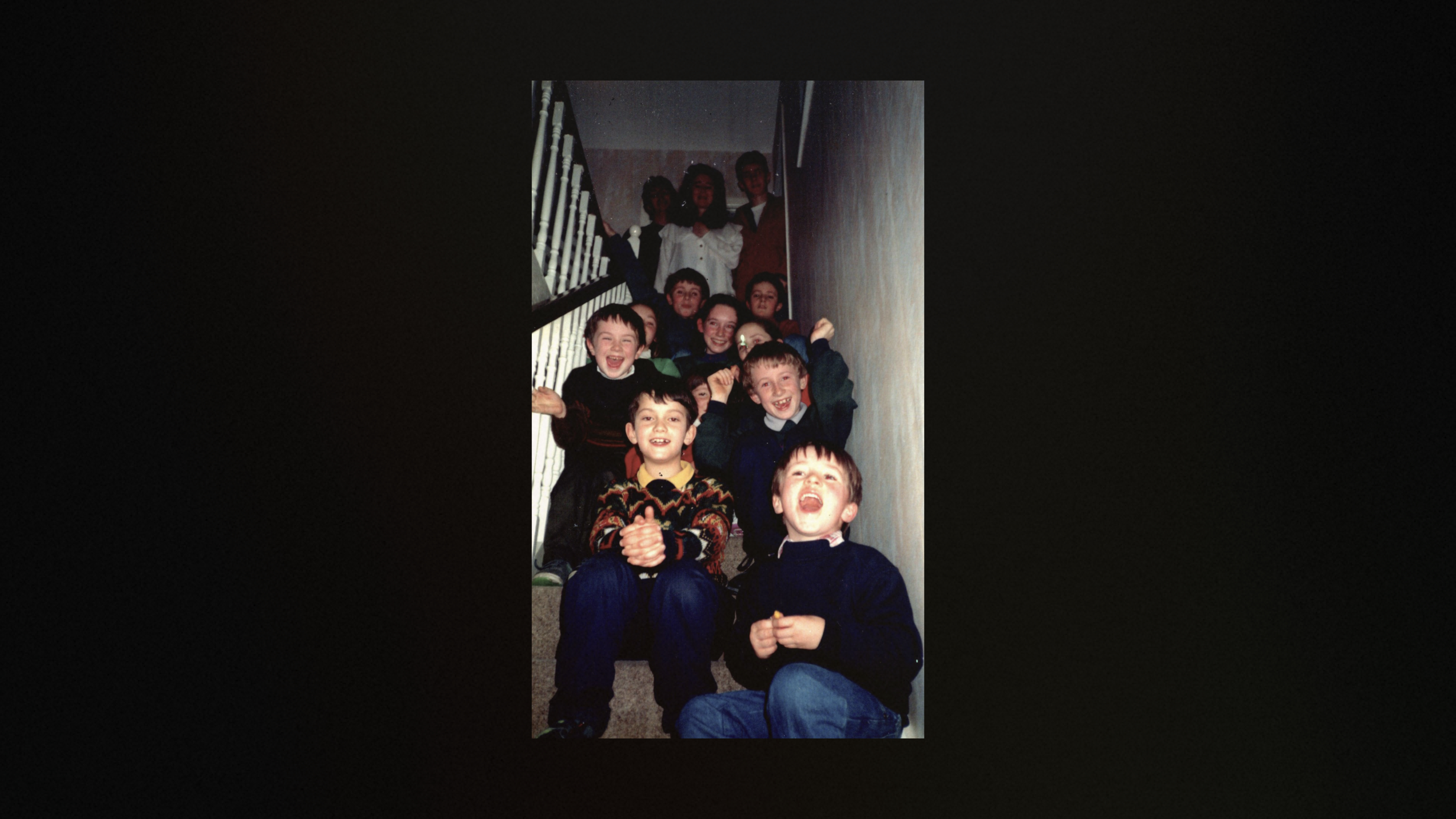
I scan the image. I’m here, but he isn’t. These are all cousins, siblings. A false memory. But I do find one of the greyest photos imaginable. Sixth class graduation. I spot Ronan among the sixty or so kids. So many uniforms. By this point, Ronan and I have drifted apart as friends. In the photos, he isn’t laughing, or smiling, or elbowing. He’s alone. Waiting for it to be over. [19]
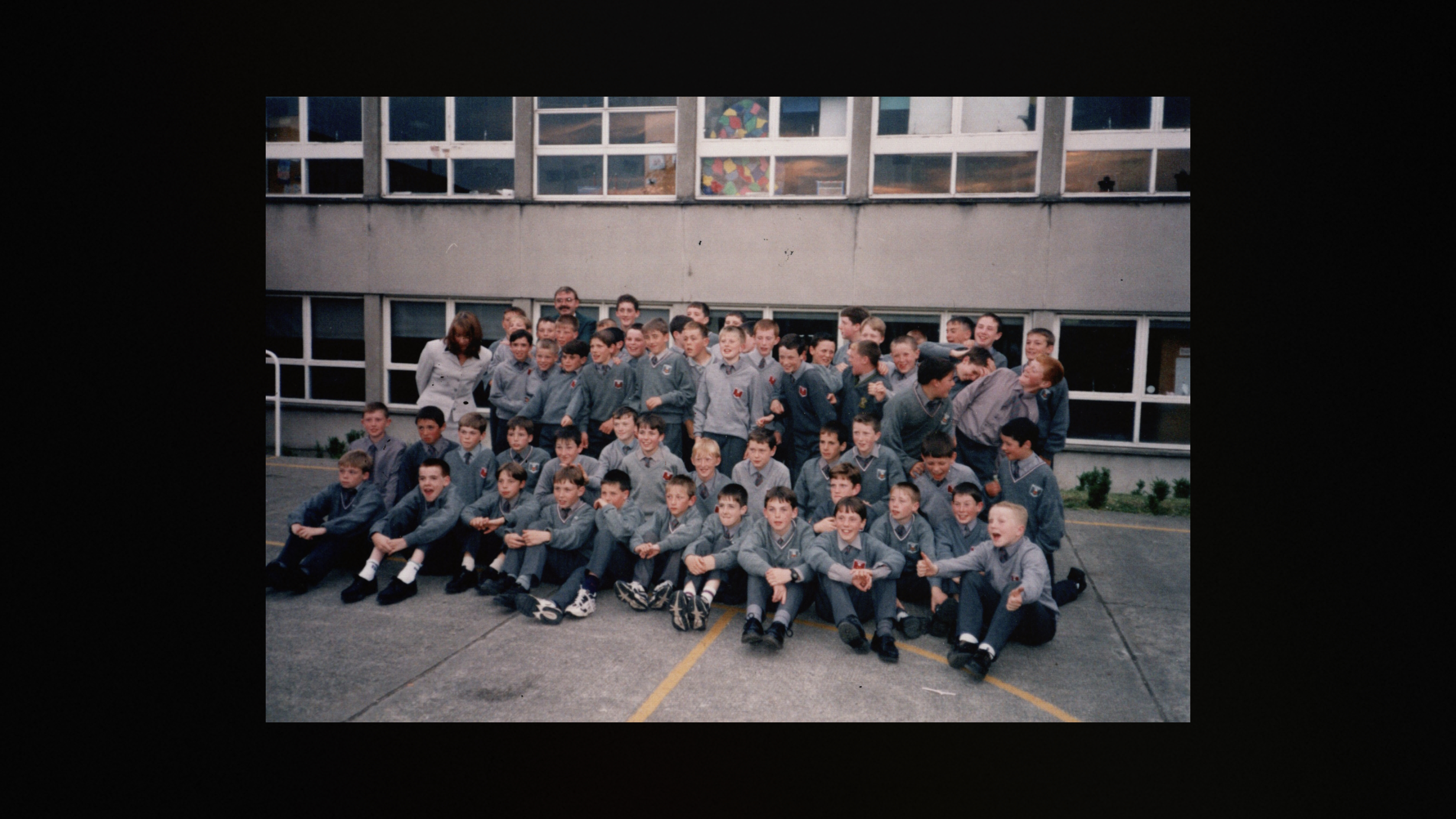
We graduate to secondary school. A new uniform, also grey. Ronan is bullied, admittedly in my peripheral view. Towards the end of the spring of second year, he leaves school altogether. I see him again two decades later, in a pub, sitting with another man our age. I fail to stop and say hello. I’m not sure how I’ll be received. Or maybe I’m afraid he’s still as unhappy as he ever was – and that I’m somehow to blame.
Ronan is not his real name. But I know he would recognise himself in this. He appears in my dreams more often than real life. Someone I have not contacted, someone I should have, years ago. Now it feels too late. In my dreams, he stands for a failure of friendship. My albatross.
*
Two years on from Mam remembering the scene in her old garden, she asks how the novel is going. ‘Well,’ I say, and begin to tell her how I’ve worked the story into the book.
I should mention, I live with my mam. And my wife, and our five-year-old daughter. Mam is deaf – profoundly so now – though she wasn’t always. She doesn’t sign, but she picked up lip-reading naturally from a young age. She’s good at it, but relating anything complex takes time – clear speech, clear annunciation, face to face. But I want to tell her about this. How her granddad’s burning uniform has found its way into the novel.
‘What?’ she says.
I repeat myself, slower, mouthing more clearly.
‘But what uniform?’ she asks. ‘What do you mean?’
She has no memory of it. I try recalling it from a few different angles, but nothing. Not the story. Not the uniform. Not the fire. My dad – who was there when she told it – has since died. But I remember the moment: the sitting room, the mid-afternoon light, the shock of reaching my late thirties without ever hearing this from her. From someone with such a precise, detailed memory. The keeper of every minor incident from all her children’s lives. Even the stories they forget themselves. Perhaps I remember it because, even then, the cogs were turning – seizing on the story as ideal material.
I even remember what had prompted her remembering. For the first time, under the reign of Leo Varadkar, the State chose to recognise members of the RIC in its War of Independence commemorations. The decision had its critics. I suspect it didn’t mean much to most people. It didn’t mean much to me. But it meant something to Mam. Acknowledgement that her grandfather was someone worthy of remembrance. It gave her State-sanctioned permission to remember. And then, it seems, to forget.
A month later, we’re at the kitchen table. Mam tells another story. Another uniform. Ronan Harte’s school uniform. She’d met Ronan’s mother in the shops that afternoon. She’d been too upset to talk properly. But the encounter had stirred an older memory – more than twenty-five years old. Ronan had come home from school after a fight, Mam says. His parents weren’t home. He went into the garden, took off his uniform, doused it in petrol and set it alight. That was his last day at our school.
I don’t remember this story at all. But surely I’d heard it before, around the dinner table, decades earlier. Mam probably heard it from Ronan’s mother then, too – and carried it with her ever since.
I don’t pride myself on having a good memory, but for someone writing a book about burning things it seems absurd that I would forget how Ronan left school. In fact, despite having no conscious recollection of it, I’ve written this exact story into the novel. In Deep Burn, an email arrives in Martha’s inbox, from a woman seeking to burn her school uniform.
MARTHA
Another uniform, she thought, and more trauma. ‘It has,’ the email stated, ‘been covered in spit, blood, semen, animal fat, ketchup, dog shit, nail varnish, Tipp-Ex, yoghurt, poster paint. It’s had compass points run through it, safety pins, scissors, pen knives. It’s got scorch marks from the day two girls sitting behind me in physics took to the hem with a Bunsen burner.’ The correspondent asked Martha to help her ‘exorcise our anger’.
BRENDAN
To say I had forgotten Ronan’s story is inaccurate. More precisely, I’ve sublimated it, and rehashed it as someone else’s. A little later in the novel, yet another uniform appears.
MARTHA
Six of the seven remaining emails were indeed from men, the first of whom was a French man living in Margate. He sought travel costs, bed and board, plus per diems to burn his father’s Free French Forces uniform from WWII, presumably thinking she specialised in military dress.
BRENDAN
By this point, I’m starting to doubt – really doubt – that Mam ever told me about her grandfather’s uniform. And if that’s the case, am I the one inventing memories of burning uniforms, and burying others I don’t want to deal with?
There is one person who might hold the answer: Mam’s brother, Uncle Martin, who, according to my recollection of her account, was standing beside her in the kitchen as they watched the uniform burn.
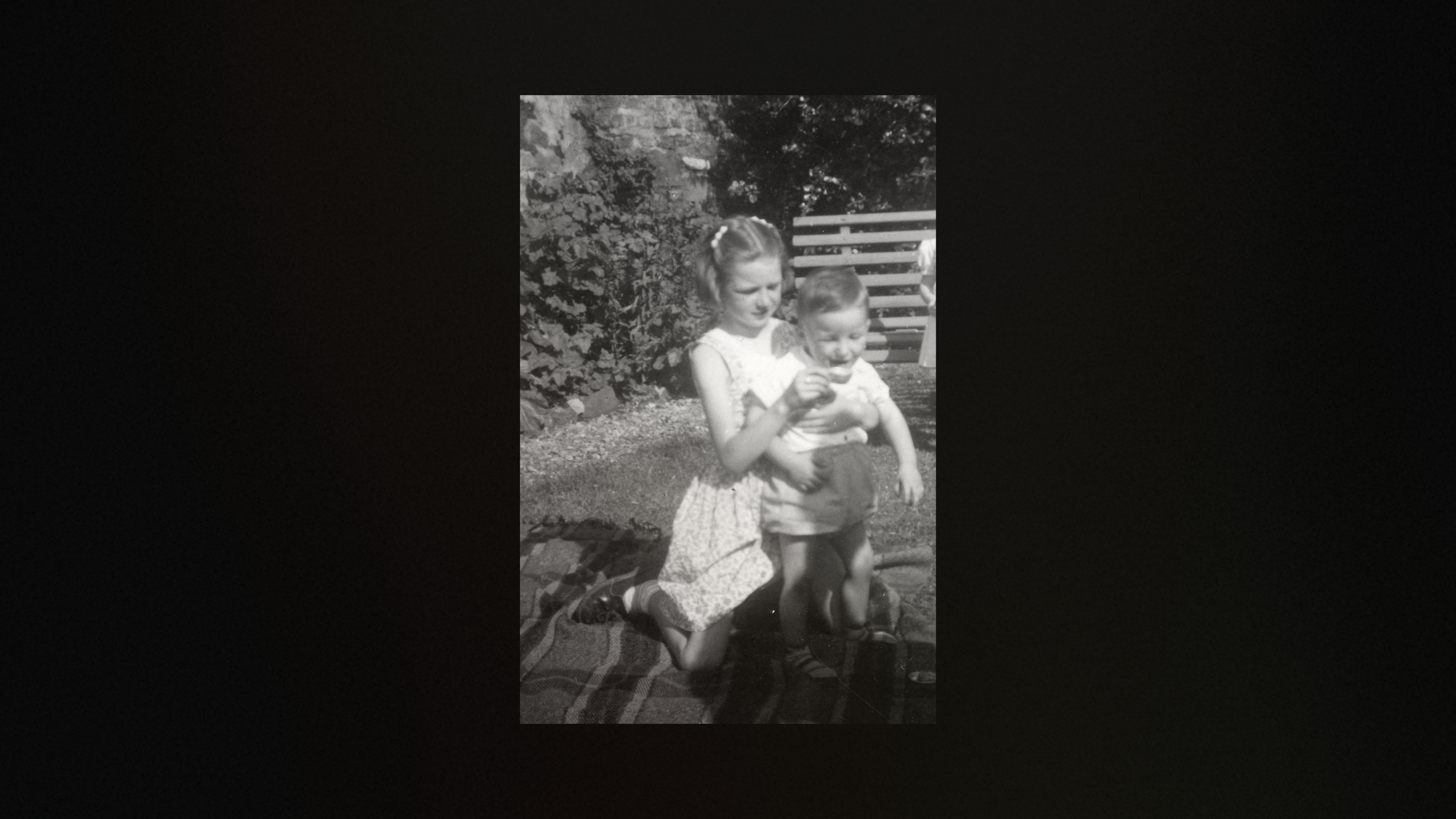
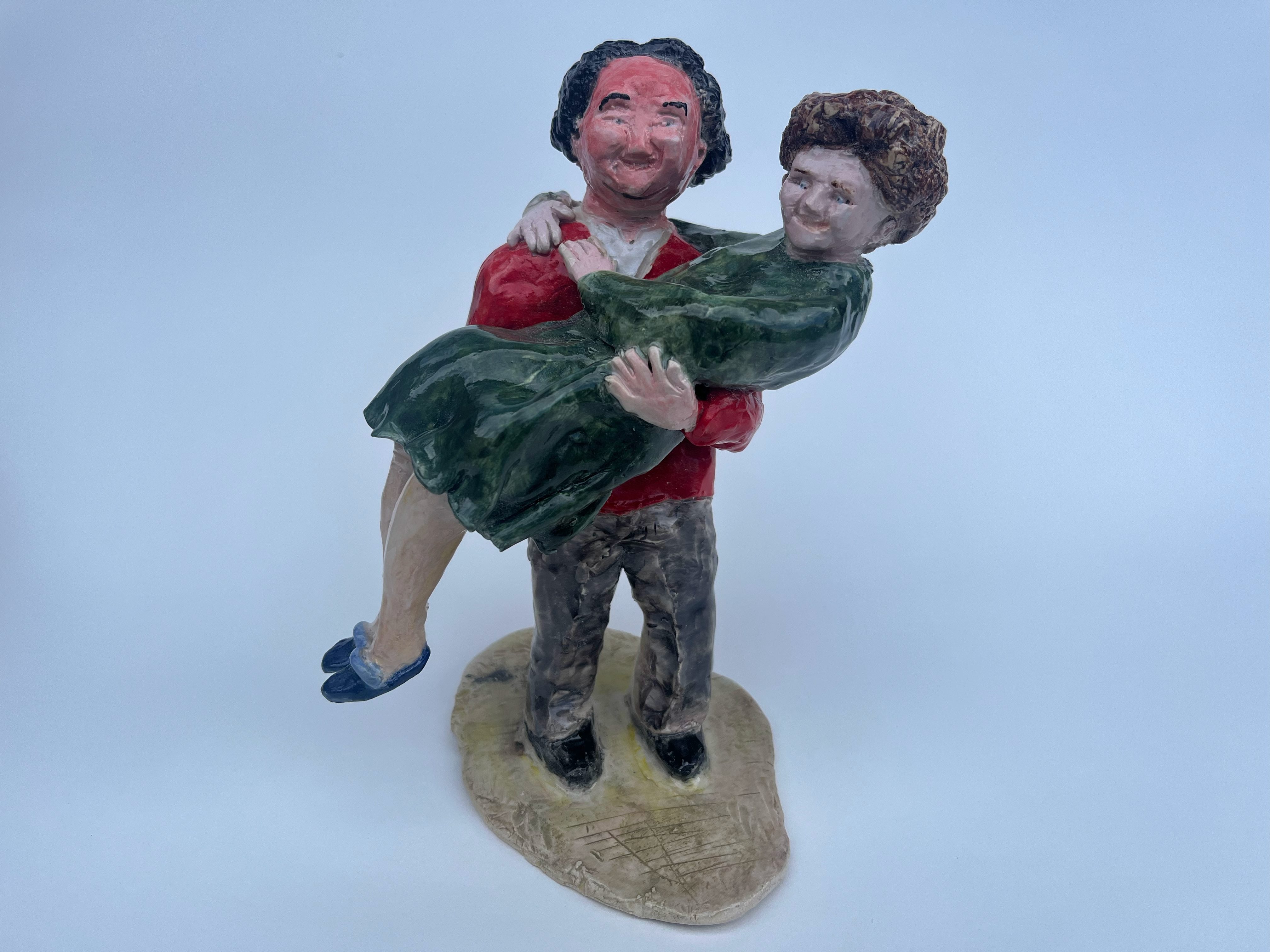
An old photo of Martin, lifting his mam, my nana, in his arms. [20]
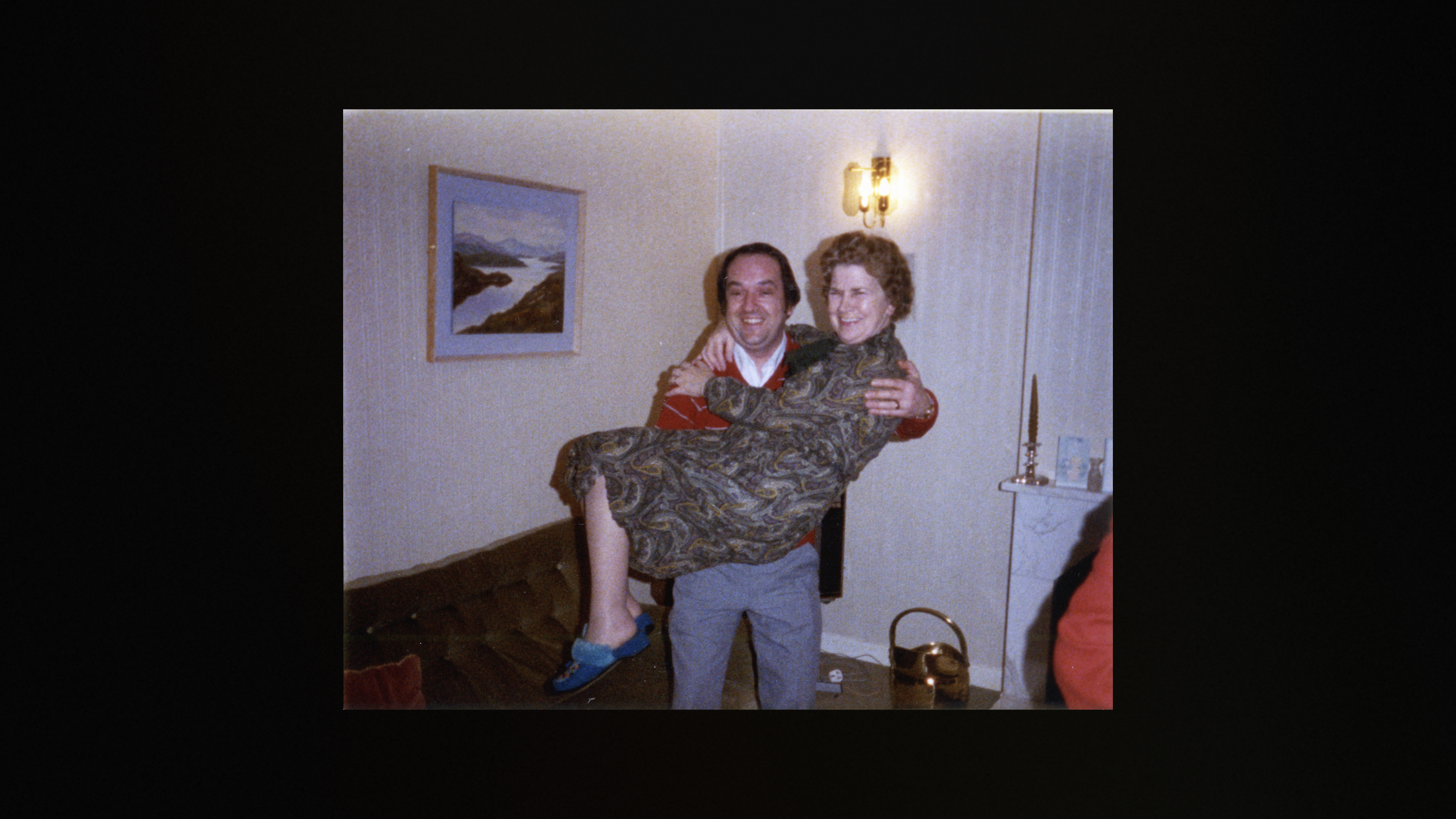
April 2024. I see Martin at my mam’s 80th birthday party. He and Auntie Val have travelled from Raheny to Connemara, despite a pain in his shoulder. After dinner, Martin, usually the wit, and gruff exterior, stands to make a speech. He talks about how his big sister has always looked after him. He repeats it. ‘You always looked after me, Kath.’ It is the only time I ever see him cry. I think to ask him about the uniform, then hesitate. I don’t want to know, not yet.
I want to finish writing this story before I know the ending – before I find out who is wrong, me or Mam. Or both. I even have an idea for how this ends. I will ask one of Martin’s children to film him. Giving his version of events. His memory of the incident. If it ever happened. I won’t watch it until I’ve finished writing about it.
Over the following weeks, I receive a series of phone calls from Martin. The first to tell me that the pain in his shoulder is a lump. He is going to the Bon Secours for tests. Two weeks later, another call. The lump, as expected, is cancer. It has spread from both lungs, into his arm and his hip.
Weeks pass and another call. He confirms it is Stage 4. They’ll start treatment soon. ‘They’re giving me one to five years,’ he says, ‘depending on how the treatment takes.’ He calls me because I live with Mam. Because she can’t hear. He doesn’t want her getting this by text. He wants me there, with her, as she hears it. The next time we see him is in the Bon Secours. He has pneumonia. They’re giving him morphine to keep him comfortable.
To keep him comfortable? We’re confused. Val is there with her two sons, trying to get answers. ‘It’s weird,’ she says. ‘He was fine yesterday, wide awake. Giving orders about how to arrange the room. And he sounded just like Nana. In lots of the things he was saying, he sounded just like her. Really formal, not like himself at all.’
When my mam and I go in, he is drifting in and out of a morphine doze. His breathing is heavy. On one occasion, his eyes closed, he calls out, ‘Mammy, Mammy, Mammy.’ He dies the next morning, at 5.27 a.m., with his family by his side.
I reveal a ceramic replica of the photo being projected, Martin lifting Nana. [21]
*
I have recognised for a while now that the stories I write are a kind of fantasy version of my life, ones in which I embed my little obsessions.
Fiction is an escape to worlds I want to inhabit, and perhaps from responsibilities I’d rather avoid. I’ve noticed too, that I infuse small parts of myself into each character, none more so than Martha. Hers is the life I’d most like to live, but have been too scared till now to pursue. That fact began to shout at me so loudly that I am now actively trying to become her.
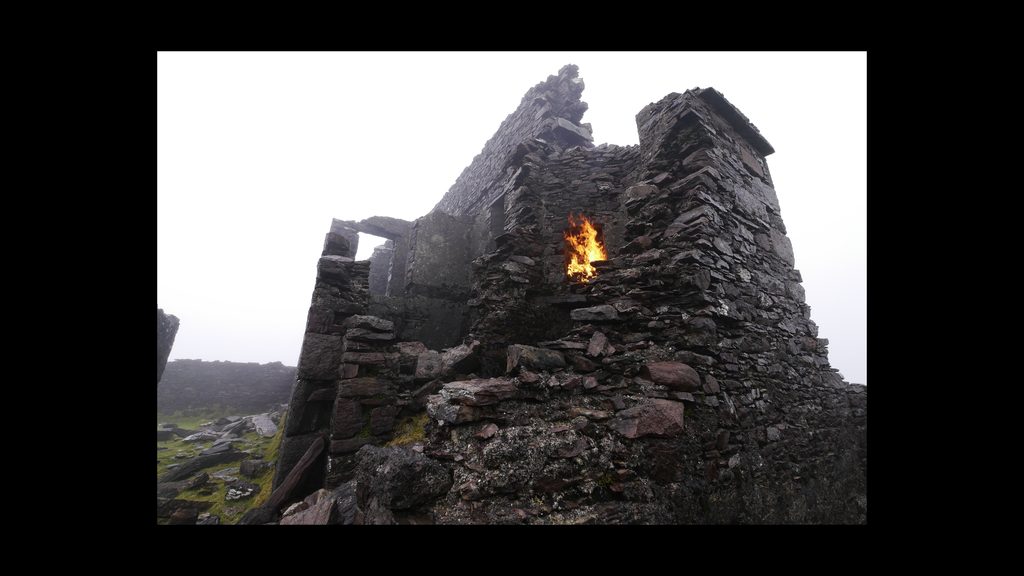
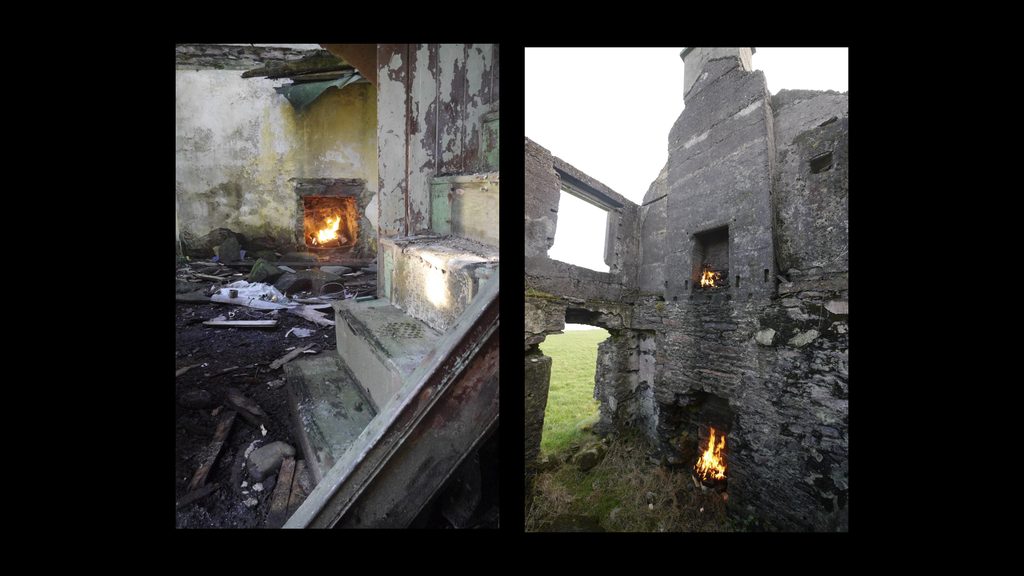
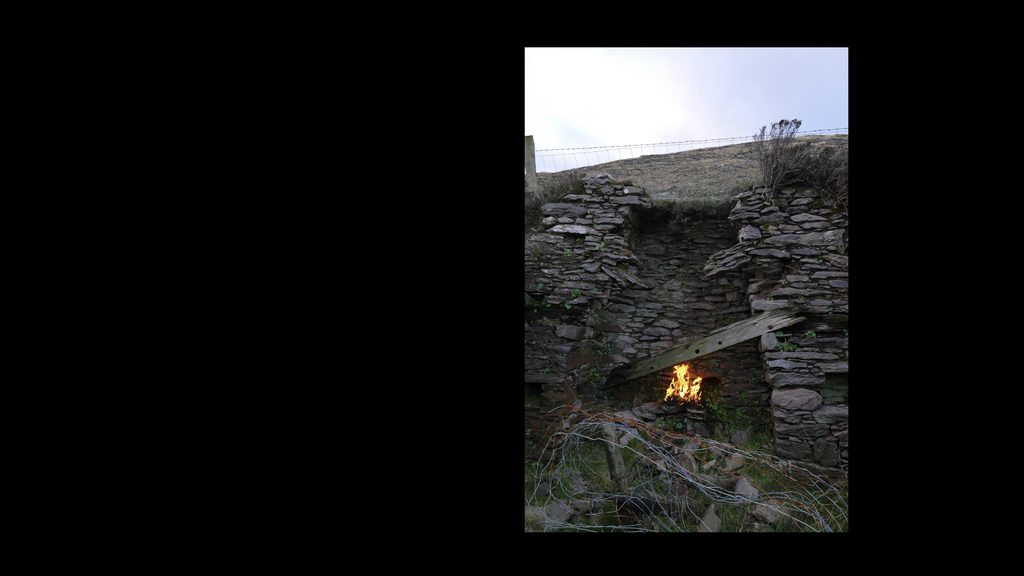
[22] A film plays on screen, shot in Sligo, where I light a fire in the fireplace of a ruined house, followed by a series of photos I shot a few years ago in West Kerry, of fires I lit in the fireplaces of various derelict houses and ruins in and around the artist retreat of Cill Rialaig. [23]
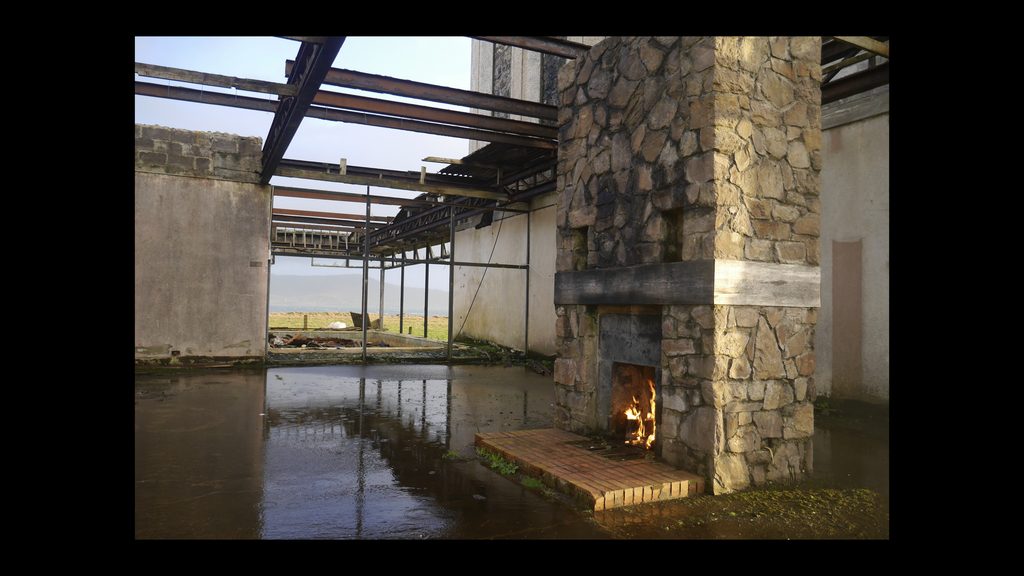
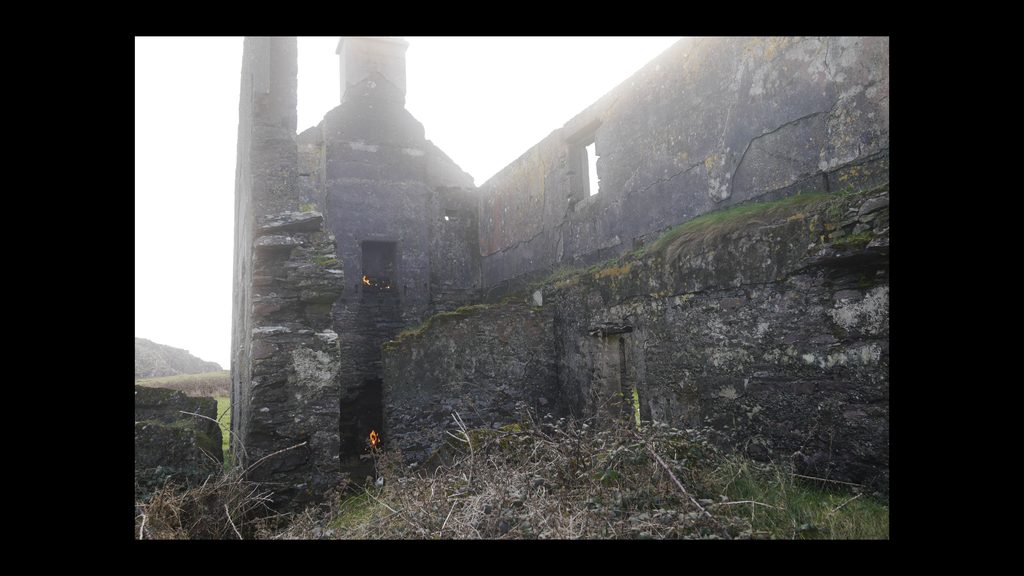
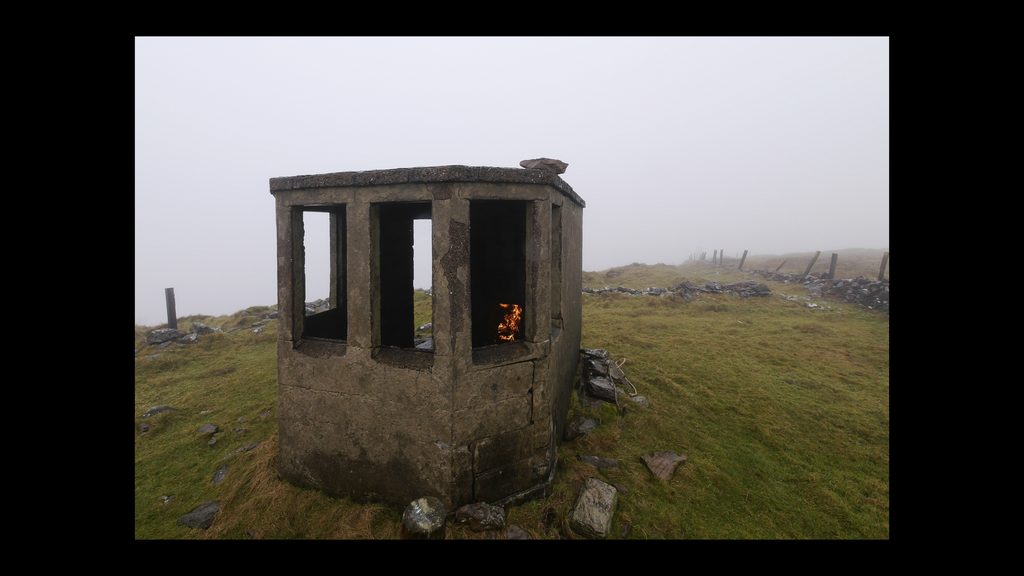
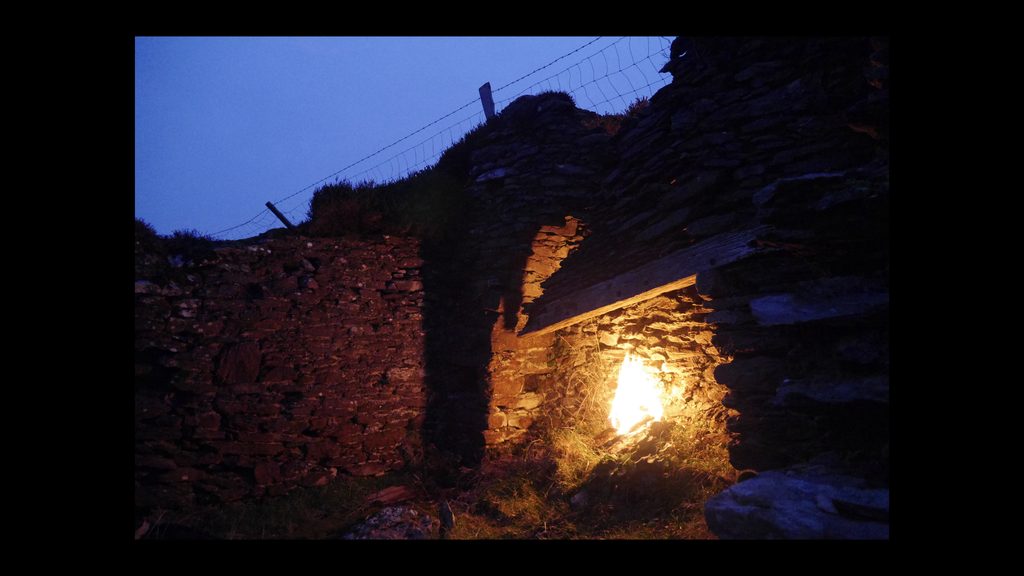
I take a seat at a second table on which rests a lump of raw clay and ceramics tools. I begin working the clay, while a reading from Deep Burn plays over the PA.
MARTHA
On her third walk of the day, before the light had completely drained, she took to filling a rucksack with turf, matches, firelighters and the camera. She walked or cycled to a different house each night to set the fire. She let the fuel burn down and watched the ricks of turf settle into themselves. She waited until the edges cracked grey at the fringes and their centre turned a rich orange ore. Then she would uncase the camera and shoot.
This was why people believed in ghosts, she supposed. There was no such thing, of course. Only weirdos like herself wandering about the countryside, mistaken for them. Yet as her project progressed, and more fires were lit, she came to hope that unseen others might materialise in her photos.
She wasn’t religious, but she took to saying a prayer for the former residents. She tried to imagine the particular atmosphere of each room on the day or night the fireplace was last lit, the sound and quality of the talk that prevailed in its warmth.
I’ve made a clay fireplace. I light a candle and place it in the hearth, then pick up the original photo of Uncle Martin lifting Nana in his arms and place it on the mantle.
BRENDAN
That’s how I started anyway, wandering the hills, trying to bring the dead to life with my mawkish fires. But now instead of destroying the real to create photos, I make things. This past year, I’ve used fire to bring the unreal to life. Objects from the novel. To keep its fictional world alive: an urn, an oil can, a hand grenade, a lobster pot.
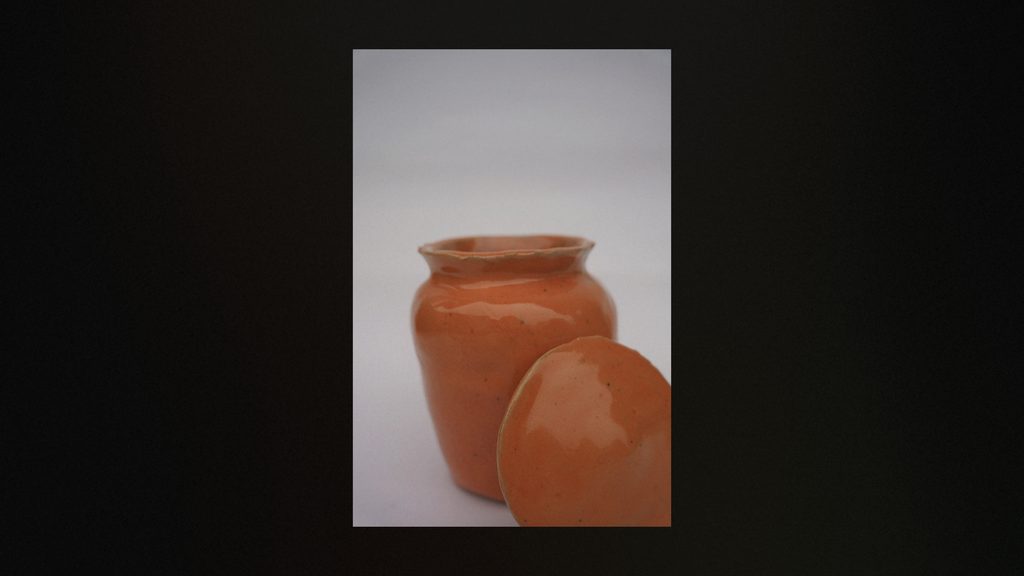
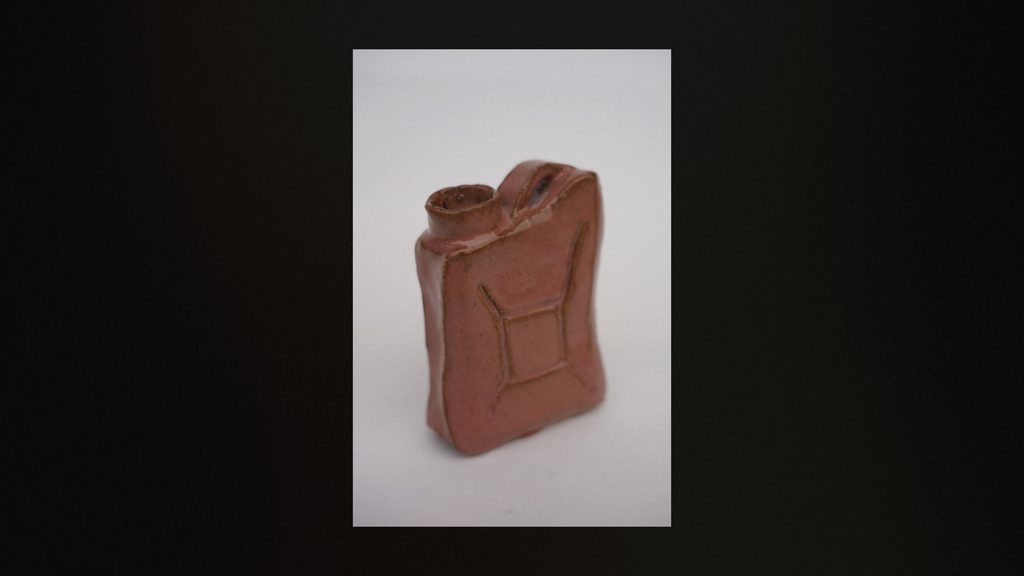
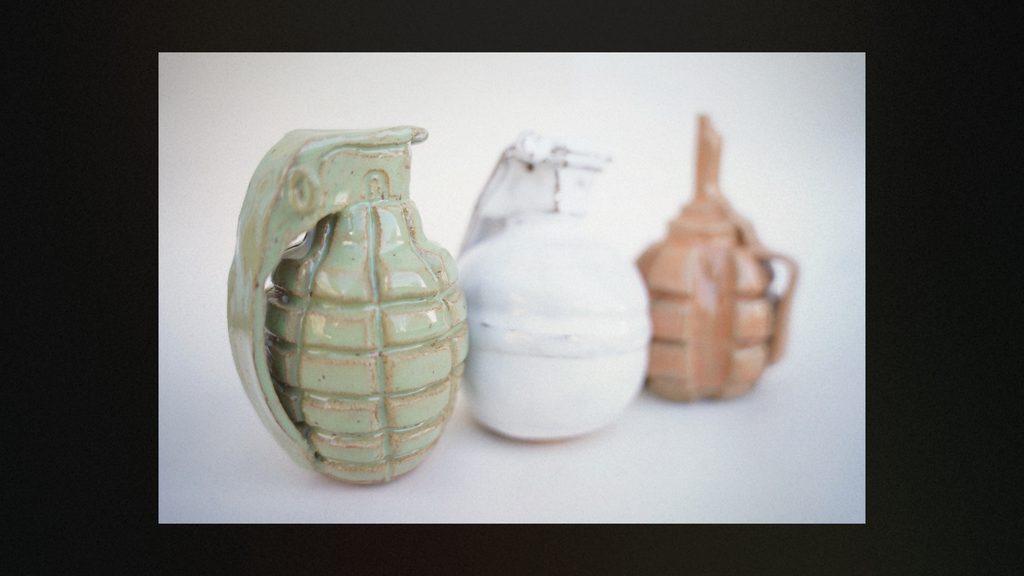
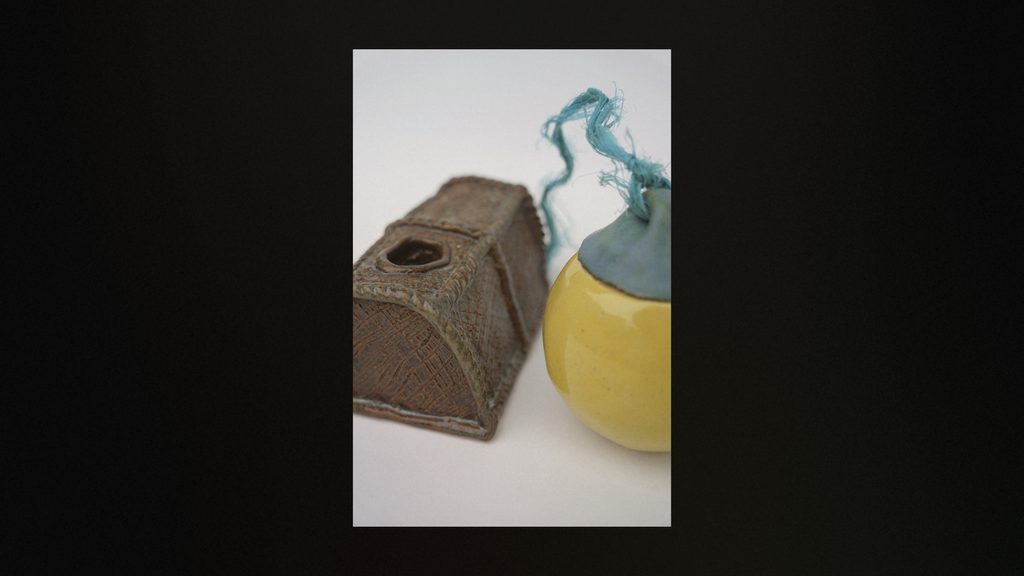
[24] I reveal ceramic versions of each from under the hessian cloth and tell stories about them. How I lost one of the best of the hand grenades in a pub and am left with an ugly Soviet style grenade for the show. How the oil can functions as a pipe and the lobster pot as an incense burner; and how I also lost the urn’s lid, so I’ll probably just blow away when I die.
I want to turn ephemeral ideas into something durable – something fire strengthens rather than destroys. And I want to tell you a true story. But without the facts, I risk making fiction and calling it history, calling it reality. Which is why I want to know the truth. Did it really happen? The uniform burning. A moment you’d think my mam couldn’t forget. Or have I blurred the lines? In my novel, stories of fictional uniforms abound, while I overlook the only factual one: my friend’s school uniform. In a final bid for resolution, I decide, simply, to ask mam again. One evening, at home, while we’re watching the World Snooker Championship, I turn down the sound, which is only on for me; I take out my phone, hit record, and see what, if anything, she still remembers.
[25] The final section of the show is a recording of me and mam chatting. I’m just standing on stage, listening to the audio. The audio is online with all the photographs and media from the show. I thought about whether to transcribe the four-and-a-half-minute audio clip. In one way, it’s OK not to listen, not to know how it turned out. Not to find out whether it was me or my mam who had invented the story. But it’s nice to hear her voice, I think. It wasn’t until the age of thirty or so that I realised my mam’s voice is different from other people’s voices, different in that her deafness has shaped the way she speaks. It was my wife who first pointed it out to me. I was astounded not to have heard what was so clear to others. If I try to hear a difference now, I struggle. More than any human voice, hers is the one I’ve listened to most, a tuning fork against which all others are measured.