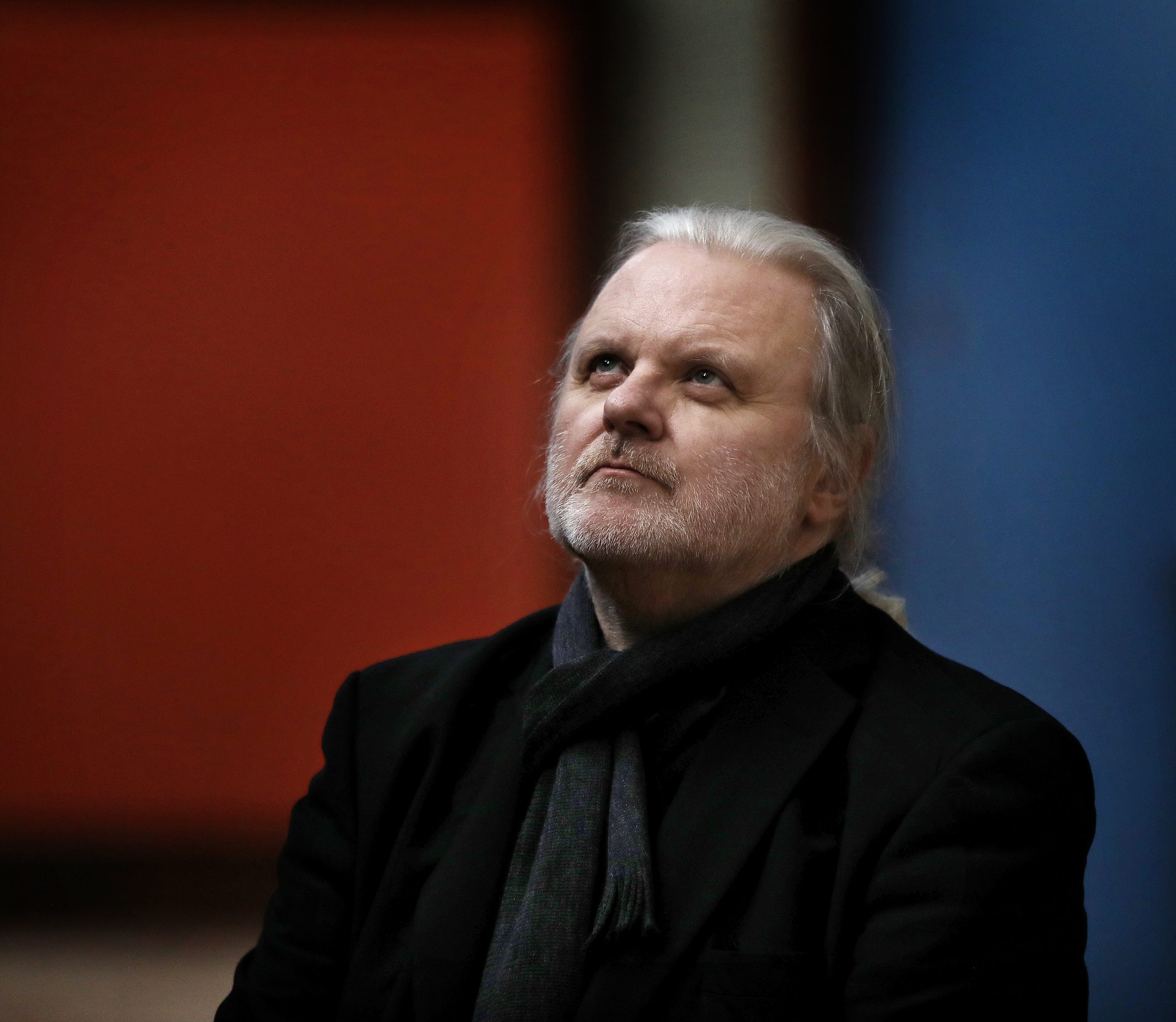
Over a forty-year career, Norwegian Nobel Laureate Jon Fosse has produced an estimated eighty works, spanning plays, essays, poetry, children’s books and novels. He writes in Nynorsk, the minority Norwegian language, and proudly so. Since winning the Nobel Prize in Literature two years ago he has already written two new plays and published a new novel, Vaim, translated by Damion Searls. It is the first of three related novels, all set in the fictional town of the title. Fosse might be famous for his slow prose, but he clearly writes quickly.
Across Europe, he is a celebrated dramatist and is said to be the most-performed living European playwright. In the Anglosphere, however, his plays have been met with mixed reviews – ‘Norway: nil points,’ as he once quipped. This perhaps reflects a culture clash: the austerity of his Beckett-influenced European aesthetic not quite providing the jazz hands expected in London’s West End.
For most Anglophone readers, it is his prose, and in particular his masterpiece, Septology, that has established Fosse’s reputation. Septology is a profound meditation on art, life, death, identity and meaning, told in a single eight-hundred-page sentence – or to be precise, told in the silences that surround that sentence. It is one of the greatest novels of our time. The translation by Damion Searls adds a second layer of genius to Fosse’s own. It is extraordinary to think that Septology was completed as recently as 2021. After a long and varied career, Fosse is still peaking.
His prose beats gently. The sentences are plain – modest, even – free from ornamental adjectives, firework imagery or strained metaphors. He is not difficult to read or understand, though reading him well takes care, and a full understanding of his writing seems to escape even Fosse himself. His characters are marginal figures – inarticulate, taciturn; people who get by, but only just. He writes especially sympathetically about older people and those unsure of their own minds. The fjords of western Norway imbue his writing with an otherworldliness. They sustain livelihoods and offer a means of transit; but so too are they dangerous and mesmerising.
It is hard to place Fosse’s books in time. They are free of tech obsessions and the weary self-consciousness of more online writers. In contemporary literature, where work is often championed for its topicality and ability to speak to the moment, Fosse’s writing is stoutly apolitical. It is also sincerely and beautifully religious. I can honestly say that his work – and the way he speaks about it – has caused me to re-examine my perspective on God and faith for the first time in over thirty years.
I previously interviewed Jon Fosse online almost two years ago. At that point he had won the Nobel Prize but had not yet attended the ceremony. His life was pregnant with change – mind-blowingly so, as far as I was concerned. Meeting him again two years later – also online – he is relaxed in his home. His long grey hair is pulled back into a ponytail and he has the same Geppetto-like glasses he wore last time. He leans back in his chair with his hands behind his head and answers freely. He is modest, polite, good-humoured, and seems at peace with himself and his situation. Behind him, gold-leaf religious icons hang on the wall of what looks like an ordinary box room. We spoke for an hour and a half, his answers and attitude unfailingly generous.
— Rónán Hession, September 2025
Rónán Hession (RH): When we last spoke, you had just won the Nobel Prize. How has life been since then?
Jon Fosse (JF): I was extremely afraid of the lecture and the ceremony. I would very much have preferred not to take part. But somehow, I also thought that it could be interesting to experience this – it’s now or never. When I arrived in Stockholm there was a certain movement to it all. It was very professional, and I was taken care of. I feel that it went really well, but still it was far too much for me. One of the best things about receiving the Nobel is that I will never receive it again.
I was asked by a Swedish paper whether I had any advice to give Han Kang when she won, and I said, ‘Learn to use the word “no”.’ After the Nobel she stopped travelling and giving interviews. She’s just saying no to all requests, so perhaps she listened to me!
RH: Is there a sense that people expect you to speak out more now on topical issues?
JF: I think I have managed to navigate that. I keep on saying that I’m just a writer and a playwright. That’s my thing. I don’t know any more about politics than anyone else. My opinion isn’t important. I don’t like to make statements about subjects that have nothing to do with what I am supposed to know something about.
RH: Your Nobel lecture was published as A Silent Language. In it you say that literary language has no message, that ‘it exists as its own thing’. What do you mean by that?
JF: I think that every piece of literature that has real value is a thing in itself. It was one of those American poets who said that a poem should not mean but be. It’s not a meaning in the sense that you’re reporting experiences from your own life. It is an artefact, as much as a painting or piece of music. You’re making art with words that are normally used for other purposes, so you have to create a distance from ordinary language in order to be able to write well.
When I’m writing, I never think about what I’m writing. What is part of what might be called ‘content’ is part of what might be called ‘form’. When I sit down to start writing something, I just start; and after a few pages, the basic technique, the subject, is already there. I continue by listening to what I’ve already written, but also I listen to something else – I don’t know what it is – that makes the story go on. At a certain point, it’s like it’s already written and I just have to write it down.
RH: Your latest novel, Vaim, the first of three related novels – do you see them as a trilogy?
JF: With, say, Septology, you need to read the whole novel to get the silent language that comes from the wholeness. For me, that was important. In some languages it was published in three volumes and then gathered into one, for example in Norwegian and English. In other languages it is only published as one volume. But it is one.
With Trilogy, I wrote the first book, Wakefulness, on its own. It took almost seven years before I wrote the second and the third parts. It was only when I had written those two parts that I realised that together it was a trilogy.
But with the Vaim stories, you can read each one and get full value, to put it that way. So I don’t think of it as a trilogy, but of course the three books are related. You could call it a trilogy if you wanted, but for me it’s more a series of connected stories – and the connection is this place called Vaim.
RH: Vaim seems to have been written quite quickly. Are all three volumes written or are you still working on them?
JF: Actually, the first book, Vaim, was written before I knew about the Nobel. When I won the prize, I was asked to give a gift to the Nobel library, so what I gave them was the handwritten notebooks and the manuscript of Vaim. I also had handwritten versions of the other two stories, but they weren’t finished. It was the summer after the Nobel, when I had some peace and quiet in Austria, that I worked through all three Vaim stories again. In other words, they were roughly written before the prize but finished after it.
When I wrote these Vaim stories, it was after I had written Septology. I didn’t want to compete with myself, be even more ambitious, say something deeper or in a more exquisite way. I wanted to do something that was almost the opposite, something not really ambitious in any way. I always want to write as well and as true as I can – that goes for everything – but you can do that on different levels. So Vaim was perhaps a reaction against Septology.
RH: Like Septology, Vaim is a single-sentence novel. What appeals to you about that way of writing?
JF: In almost all of my novels I have written quite long sentences. Not complicated sentences, not German types of sentences, but sentences that are essentially many sentences hooked together. I have written fifty-page sentences without a complete break, for example in Aliss at the Fire, but I had never written without a complete stop before Septology, though I had been very close to doing it several times. With Septology, I didn’t plan or intend to write without full stops at all. I just wrote it that way. It felt right.
I used ‘and’ and then ‘and’ – it’s like the Hebrew Bible where there are no stops. It just continues with ‘and … and … and’. In the Nynorsk version of the Hebrew Bible, they kept a lot of those ‘and’s, so I think that has been an influence on me. It was the Bible I grew up with, in a very old-fashioned version of Nynorsk.
RH: Returning to Vaim, we learn a lot about the main character, Jatgeir, through his interiority rather than his speech. Even in your plays, characters often have only one sentence to deliver, rather than Shakespearean speeches. This is a common feature in your work – you don’t like the characters to be too talky.
JF: Shakespeare managed to say everything in words. I am very sceptical towards what words really can say. While you write in black, what is most interesting is what is written in white. It’s a question of making the black writing tell us what’s in the white writing. It’s the opposite to the Shakespearean attitude to language. He’s really great at doing that, of course – no one’s better.
I think there are some similarities with my writing and, say, the way Beckett is writing, though he’s more outspoken and he plays more with language. I do that very rarely. He’s the English-language writer I feel closest to, of the big names.
RH: In Vaim, there’s an interesting male–female dynamic. The male characters are quite docile and easily manipulated. The women characters are fairytale-like in their wickedness. There’s almost a folk-tale feel about it.
JF: Yes. I think especially with Eline in Vaim – she’s not a ‘real’ person, as such. She’s more like a figure in a folk tale. She’s one-dimensional, to a large degree. All the Vaim novels have a certain folk-tale quality to them.
More generally, in my writing you find a lot of outsiders or loners. If there’s a female character, she’s quite domineering towards this quiet, or lost, male. They’re not really lost – they manage well and live the way they want to live, mostly, or most of them do. But they are not very ‘active’. There’s not much action to the male characters.
RH: It’s clear from the book that you’re very comfortable with the terminology and the practicalities of boats.
JF: Yes – I keep a boat myself. I grew up, more or less, on a small boat – my father had a boat. I’m not at all an autobiographical writer. I never do research, so I’m using things I know about.
I grew up on a fjord near Hardanger and also on an island towards the North Sea, so you know about boats and the sea and the waves. It has been very formative for me.
We grew up near the sea, and when we went to school we were walking along the coastline, by the fjord in Hardanger, and heard the sound of the waves all the time. And I remember clearly, when I lived in Ireland for those winter months in Spiddal, that sound of the waves. We rented a house near a churchyard, and there were these large, rounded stones with the waves coming over them.
RH: Do you resist metaphorical interpretations of your work?
JF: When I’m writing something it has to be right in each and every respect. The rhythm has to be right, the position of the narrator, and so on. Each text needs its own logic. If you look at Vaim or Septology or my other books, they’re all different but they are also similar because I’ve written them from my own formative experiences. But the logic of each book has to be completely its own, and I have to stick to that logic. And that’s what I’m concerned about – not the meaning of this or that. And if I’m asked what it means, I cannot say. I can interpret myself, in the same way you can interpret it or anyone else can. But if you’ve read it well, then I’m not more capable of finding the right answer than you are. I’m not making riddles at all. Life is very simple but also impossible to understand. It’s a huge riddle in itself. I’m trying to write it as it is, and it becomes completely enigmatic. And the answer to this enigma? I cannot say. I know exactly what I’m writing, but nothing more.
RH: You mentioned before that when you were a younger man, you were a socialist. There isn’t a strong political flavour to your work but there are clues about class and money throughout your writing.
JF: The characters are not based in the working class, but they obviously don’t belong to a bourgeoisie culture. They are quite normal people.
My whole adult life I have been an artist – I’ve never had a full-time job anywhere. But I know what it is to be a poor artist very well. The thing about that is that it’s not just about how much money you make, but how much you spend. You can manage to live on very little if you have to. And I’ve been living like that for many years. I did a lot of small work to earn money, like writing for magazines, reading manuscripts for my publisher. For several years, I taught creative writing and worked part-time as a journalist.
RH: I’m sure that’s changing for you now.
JF: Once poor, always poor. The attitudes are the same. You don’t get rid of them. You’re so used to not spending money that you never escape from it. I’ll be sixty-six this year and you can’t change me in that respect.
RH: You seem to have a large reservoir of characters – how do they come to you?
JF: More and more I feel that, in order to write – at least, to write the way that I write – that it’s a gift I’m getting. Each new text I’m writing, it’s not written by me, actually. It’s a gift. A kind of grace. In terms of what made me a believer, it was my own experience from writing. Thinking about where it comes from – it doesn’t come from me, or only partly from me. It’s my voice and my technique, my language, etc. The rest has come from somewhere else. Not from inside me – from outside. Out there somewhere.
RH: Is there any character you have written about over the years that has never left you? Oline from Melancholy II has always stayed with me.
JF: I agree with you – I also like Oline in Melancholy II. She’s one of my favourite characters, I think. When I finished Melancholy I about the painter Lars Hertervig, I felt I could continue writing about his life, like another Proust, but I didn’t have the energy. For me it was really tough to write Melancholy I. When I finished it, I was very tired and didn’t want to write any more fiction at all. But then I felt I had to finish it off, seen from another perspective. Lars Hertervig had several sisters, but Oline is a fictional sister. It’s pure fiction – all of it. I’m fond of her. The part I’m most happy with is the final part when she’s on the toilet and she’s looking at this painting that she has never liked – that’s why it’s in the toilet – and she’s looking into the fish’s eyes, and she disappears into the eyes of the fish. I wasn’t especially Christian when I wrote that but it’s a very Christian image.
RH: You have translated The Plains by Gerald Murnane. What interests you about his work?
JF: It is unique. I’ve never read anything like it. A kind of solipsism. It’s hard to describe – it’s not a monologue or realistic narrative, nor a dream-like narrative. It’s completely something of its own. There is this distance that is relaxed but at the same time nervous. It’s so disconnected, in a way, to the world. It’s saying something interesting. It has a huge knowledge of being in the world because of this strange distance. If you read it and understand it, it’s obvious, but to describe it is very hard.
RH: There’s an element of obsession at the centre of it.
JF: Yes – in The Plains there is a sense of obsession. No doubt about it.
RH: Another writer you mentioned previously was Dag Solstad, who died earlier this year – what did he mean to you?
JF: I always admired his writing. I admired him as a writer and as a person. In a way, admiring someone means it’s not as easy to talk to them. It creates a distance. He was older than me and the generation before me. I’ve read a lot of him and really liked his novels. His wife is around my age, and I knew her before they were married. I got to know Dag Solstad through her. We met a few times. The year before he died, we met in Austria – he was very reduced by then – he couldn’t walk without help from me and his wife. But we had a very beautiful meeting there in Hainburg an der Donau in Austria.
He read Septology and he liked it a lot. He didn’t tell me but his wife told me. I’m mentioned in his last published novel. The main character is picking books to read, and he finds me and some other writers and calls us ‘good negative spirits’. That’s the sort of author he liked. I know he liked my work, but it was very much reciprocal.
RH: Following the Nobel, a new Fosse Prize for Translators has been established. How did that come about? I know your German translator, Hinrich Schmidt-Henkel, won the inaugural prize.
JF: Yes, he has translated an enormous number of Norwegian books – about 120 altogether. He has translated everything of mine in Germany but that’s only a tiny portion of all he has translated. It was an initiative by the National Library in Norway. They wanted to celebrate my prize, but the director of the library felt it would be an opportunity to get support from the government in Norway. So he spoke to me, and he raised the money and organised this Fosse Prize for Translators, as they call it. I’m really happy about it. I guess it’s the biggest prize for translators in the world. Translation is the biggest language in the world.
RH: Could you tell me about the new plays you have written – Einkvan and Strong Wind?
JF: After many years, I stopped writing for the theatre, I stopped drinking, I didn’t travel anymore. So, for fifteen years, I didn’t write anything new for the theatre. But when I finished Septology, I wanted to keep on writing, so I thought, why not write a play? I wrote a play called Strong Wind. After that, I wrote a couple more plays, one of which was Einkvan. This theatre in Oslo decided to produce it. I don’t want to take part in rehearsals or have any opinion on which actors take part. What I am responsible for is the play. Or specifically, the play as it is published in Norwegian.
It has been very important to me to have my plays published, because, to me, they are literature. They belong to my literature. I’m a writer, I’m not a man of the theatre. When I started out writing for the theatre, I disliked going to the theatre. Of course I read Beckett and Shakespeare, but I read them as literature. That’s still my position. I’m lucky that my Norwegian publisher wanted to publish my plays. Actually, everything I have written for the theatre has been published – even in English, in fact. The newer plays are also going to be published in English.
I met an American director, Robert McNamara, recently, who told me he did a production of Strong Wind in Dublin. He’s an American but many of them are Irish by origin, as he is, too.
RH: Before we finish, have you read anything good lately – for pleasure?
JF: I have been reading lately about Kabbalah – Jewish mysticism. There is a Jewish museum in Vienna. They had read my novel A Shining and found many similarities between Kabbalah and this story. So they organised an evening at the museum where a German actor read from the German translation and there was a conversation between me and one of the translators. I didn’t know anything about Kabbalah, but it is very interesting. I’ve read a few books about it lately. I see many similarities with the medieval German mystic Meister Eckhart, who I consider my spiritual guide.