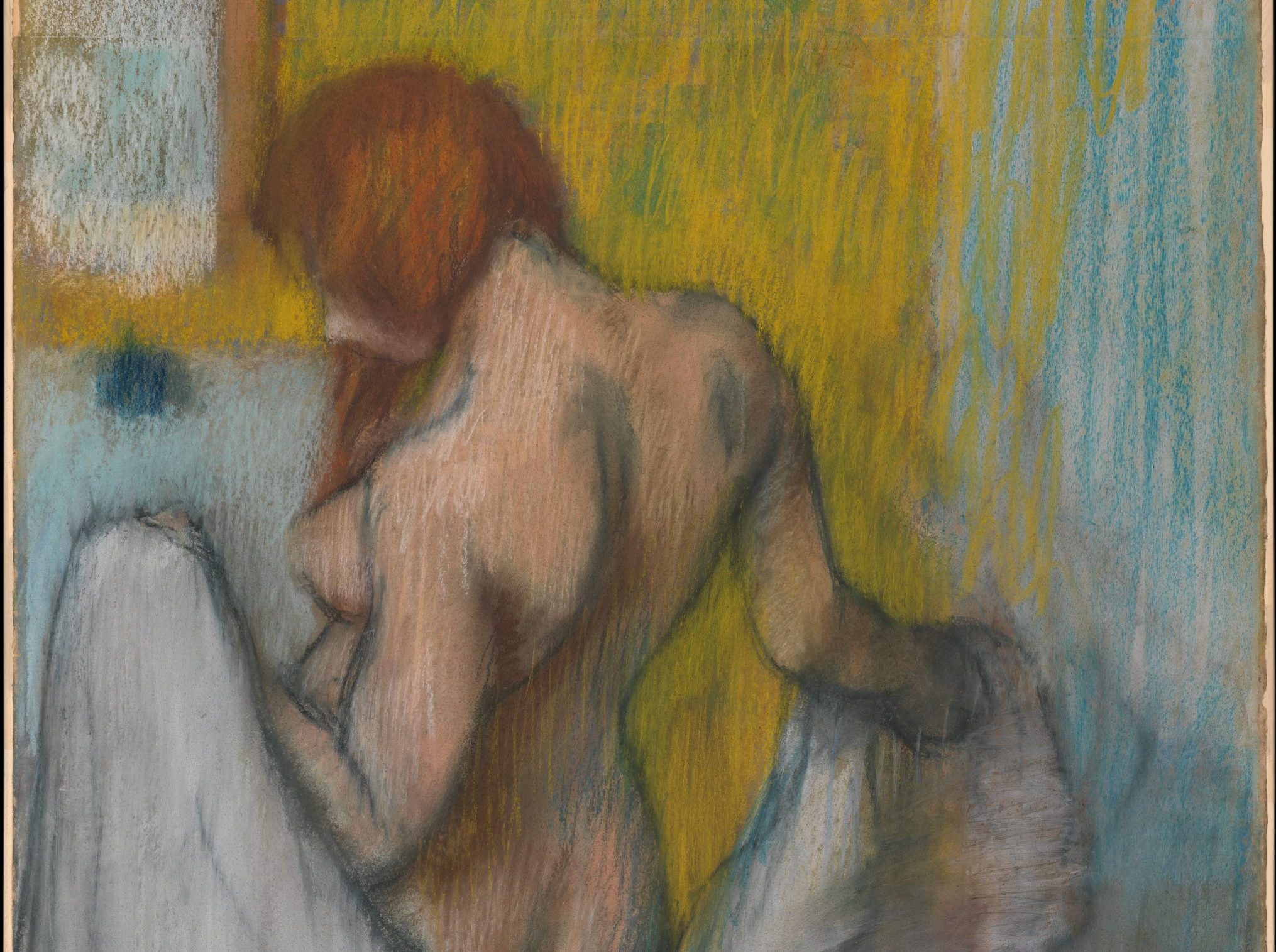
Don’t be angry if I tell you that it is the aim of my life to get people to look at me. Why should you be angry about things that don’t concern you? I’m angry when I do something wrong, but when somebody else behaves badly I’m pleased.
*
I had lived in England for nine weeks and was steadily becoming more strange to myself. Because I had come here more or less alone and for no good reason, all of my minor humiliations and losses had no narrative or audience. The things that happened to me were public, but not in any meaningful reality of mine as the people who witnessed them had no connection to my life. My feelings were suspect and dream-like, merging as they did with half-forgotten adverts and television shows. I stood at Waterloo Bridge one night after work and was quietly excited but felt that I would never again be sure if such things were real or were absorbed from tourist boards and cinema in an effort to cope with the trauma of existing here.
The person I was in love with had moved suddenly to another country. Other men, who I hated, were boring but necessary consolations to pass the time. I worked sixty hours a week for minimum wage, ate packaged carrot sticks and hummus for dinner at 11 p.m. I felt numb and self-perpetuating except in transit when I broke down frequently and with unattractive self-pity. There was an evil pushing at the world and all it needed was a little give, a little slipway. It was when I travelled it seemed in greatest danger of reaching through – when I ran until I was nearly sick but missed the last train home anyway, when a display board said my bus was coming in two minutes, but kept on saying this, unchanging. In these moments the great and pointless dread of London seemed most apparent and intolerable. I felt my body growing apart from me, swaying in these stations at night, trying not to be where it was.
I went on some dates with a sweet and oafish boy who seemed several decades younger than me, though it was just that he was happy and reliably employed and somewhat stupid. He did odd things, like steal the garnish from my cocktail when I had excused myself. When I failed to notice and a dozen minutes had passed, he unfurled his clenched fist to reveal a wilted mint leaf and a crushed and bleeding cherry, saying ‘surprise’ and, more faintly, ‘gotcha’.
Housesitting for a married couple I know, I went a little more nuts, left alone for too many days in a row. I raided their liquor cabinet and watched Scream 1, 2 and 3 on their projector and called in sick to work. I was chatting with an old boyfriend one night, telling him about my increasing indifference to my own welfare.
‘It sounds like you’re suffering from depression,’ he said.
‘No,’ I replied, ‘I think I’m just suffering.’
Then he said an odd thing: that if I was meeting strangers to have sex with them, I should stop doing so. He said I was vulnerable and physically weak and that the city was full of people whose motives could not be predicted. Well, OK, I thought, let’s go – like it was a dare.
I joined a popular fetish site and dispassionately ticked the preference boxes. Submissive. Not into pain. Soft yes. Hard no. I tried to remember what my soft yeses and hard nos were when I was sleeping with someone I loved, how different they might be with a stranger.
It is not hard to find a taker when what you are offering is a woman willing to be hurt.
*
1. When Jesus got out of the boat, a man with an impure spirit came from the tombs to meet him. This man lived in the tombs and no one could bind him anymore, not even with a chain. For he had often been chained hand and foot, but he tore the chains apart and broke the irons on his feet. No one was strong enough to subdue him. Night and day among the tombs and in the hills he would cry out and cut himself with stones.
2. A man preoccupied by his skin who believed that it was too loose. He used a staple gun on both sides of his face in an attempt to keep his skin tight. The staples fell out after ten minutes and the man narrowly avoided piercing his facial nerve.
3. A man who was preoccupied by the appearance of his chin deliberately cycled into the back of a lorry in an attempt to fracture his jaw so that it could be reset in his desired position. At the last moment he decided against the plan and dropped his head, fracturing his skull.
4. In an unnamed European country, a medical case study refers to a man who was obsessed by the shape of his nose. Lacking the means to get cosmetic surgery, he carefully chose and cleaned a piece of chicken cartilage. Looking in the mirror, he makes a deep cut down the centre of his nose and goes about trying to replace the bones with the chicken cartilage, which he has moulded to his ideal shape, thinking, Finally, finally, finally I’ll be free. Oh, do it, you motherfucker, finally, finally, finally.
*
I read about the messy corpse of a man who had thrown himself off a building. A witness reports that without fuss or warning, he neatly dips forwards as though he had merely dropped something beneath a table and was attempting to retrieve it. When a doctor arrives, he must check as a matter of course that the heart has stopped, and using a stethoscope hears and then feels a strange crackling sensation throughout the man’s chest. It sounds like Rice Krispies when the milk is first poured on. The man’s lungs had exploded upon impact and all the pockets of air normally contained within them were now travelling around the body at speed, trying to settle.
Lungs are light as spirit because their tissue is so thin and delicate; the membranes within them arranged so as to maximise exposure to breath much as the leaves on deciduous trees maximise exposure to air.
When you do not believe that you are alive, you live psychotically, pretending to have no body. The implicit meaning in my way of life is: ‘I am only what others regard me as being.’ My way of seeking to obtain conviction that I exist is to position myself as an object in the world.
Because my world is unreal, I must become an object in the worlds of other people, for objects seem to other people to be real, and sometimes even calm and beautiful. But to be an object for someone else necessitates the presentation of myself, a constant unveiling, an offering of my utility in all its forms. In a world full of danger, to be a visible object is to incite violence. The fact of being seeable exposes an animal to the threat of attack from its enemies, and no animal is without enemies.
Since I know that I am not alive, to be looked on as though I am pains and bewilders me. To be seen is such violence – because I can never truly become an object, which is unchanging and knowable. My face feels flayed, an eyesore, and I’m constantly boiling with anger at the people who accidentally look upon it. I find my ways of playing possum and trying to disappear or fade as completely into my surroundings as I can.
*
1. A patient suffers from a monothematic delusion and denies ownership of a limb or an entire side of their body. Even if provided with undeniable proof that the limb belongs to and is attached to their own body, the patient produces elaborate confabulations about whose limb it really is, or how the limb ended up on their body. In some cases, delusions become so elaborate that a limb may be treated and cared for as if it were a separate being. Patients may, for example, mistake their arm for the doctor’s arm.
2. A man preoccupied by his facial skin said he would use sandpaper as a form of dermabrasion to remove scars and lighten his skin.
3. A man who was preoccupied by redness on his skin repeatedly exsanguinated himself by a syringe and needle or, when he was accepted, by going to blood transfusion clinics to ‘make himself look paler’.
4. A woman who was preoccupied by the ugliness of multiple areas of her body who desired liposuction but could not afford it used a knife to cut her thighs and attempted to squeeze out the fat.
*
The man lived in Hampstead and was a lawyer, his house incredibly beautiful and tasteful and completely without characteristic. It seemed eerily sealed, contained, in a way that implied secrecy and, feeling this, I realised I was frightened and that being frightened was the whole point of my being there. The man asked me if I had told anyone that I was coming to meet him. I told him I had, but I hadn’t. I had orchestrated the situation to be as dangerous and foolish as possible, to be a red flag waved in God’s face, saying: I’m here, I’m finished being able to take care of myself, so whatever happens now is up to you.
Thinking of the fact that nobody in the whole world knew where I was at that moment suddenly brought tears to my eyes, the acrid loneliness of my new life, all the people at home I had left and rejected in order to get it. Being there, in this lawyer’s beige living room, was the proof I was seeking that my body is extraneous to the goings-on of the city, that it moves around unnoticed, that it is not a thing that can be needed or missed.
When he touched me and restricted my movement I began to shake with fear. For both of us the game is this actualised potential of violence – that he really could kill me, that I really could be killed. And this was enough for both of us, what we had come there to do. I tasted hot metal in my mouth, my pulse soaring. I thought parts of poems, prayers, thought of the person I love, thought: Oh, God, give him back to me, I will not stop asking you.
I thought of other people I have loved, of my sweet first boyfriend, the son of a famous actor, who was the first person I ever knew to be both rich and unhappy. We walked together through a river behind his house after having our immeasurably careful sex. Between our feet, salmon swam – beautiful slick salmon, silver – and I laughed with pleasure to feel them slide cool against me. There they were, touching off of us, and yet from a different world to ours. Their world was one we couldn’t be a part of, one where air and weight meant different things; one which, like ours, seemed to be held together by absolutely nothing.
Afterwards the lawyer led me to the door and somehow that was the worst part, anticipating him turning around with a grin and refusing at the last moment to let me leave. The moment the lock clicked I pushed past him and ran through Hampstead Heath, my face hot and thinking go go go. I knew from the animal spite in my heart when I saw that he wanted to hurt me that I just don’t want to die, don’t want to, and so I ran and ran, and as I did I thought to myself what I wished for someone to say to me, what I wished the person I love would say to me, what I wanted to say to him for the rest of our lives, which is simple but also everything and is: Don’t die don’t die don’t die, rushing with the blood sea crashing in my ears, don’t die.
*
In May 1998 a seventy-nine-year-old man from New York travelled to Mexico and paid $10,000 for a black-market leg amputation; he died of gangrene in a motel. The man had Bodily Integrity Identity Disorder, a condition in which the sufferer is persistently obsessed with the idea of amputating one or more of
their limbs. The man saw his healthy leg as an aberration.
Sufferers believe their body is incomplete with its full complement of four limbs, and they will only feel normal when they have three. ‘I have always felt myself to be an amputee,’ they say. Of thwarted attempts at self-surgery, they say, ‘It was an attempt to see myself, to be myself, as I have always known or felt myself to be.’
‘My left foot was not part of me,’ said one amputee, who had wished for amputation since the age of eight. ‘I didn’t understand why, but I knew I didn’t want my leg.’ A woman in her early forties wrote to me, ‘I will never feel truly whole with legs.’
A man who had packed his leg in ice hoping that doctors would be forced to remove it said: ‘I knew not my leg. It was utterly strange, not mine, unfamiliar. I gazed upon it with absolute non-recognition. The more I gazed at that cylinder of chalk, the more alien and incomprehensible it appeared to me. I could no longer feel it as mine, as part of me. It seemed to bear no relation whatever to me. It was absolutely not-me – and yet, impossibly, it was attached to me – and even more impossibly, continuous with me.’
I spoke to a man who owned a farm in Iowa who told me: ‘There was one time I had a labourer working here on the property and I started my chainsaw to cut off a small tree close to the ground so he could easily remove the stump. I was standing on the side of the hill with this chainsaw in my hand and I just thought, Oh, it would be so easy. The temptation was very real.’
*
When it’s all flowing at the right pace I start to take my time. It’s almost operatic now, or— What am I talking about, I’ve never even seen an opera. I know what I mean, I mean like in Silence of the Lambs when Hannibal Lecter is beating one of the prison guards to death with his own truncheon. The camera is focused tightly on him as he kills the cop, his movements elegant and rhythmic. Blood is spattering increasingly onto his face, and on it you can see – you can see just, Ah, bliss.