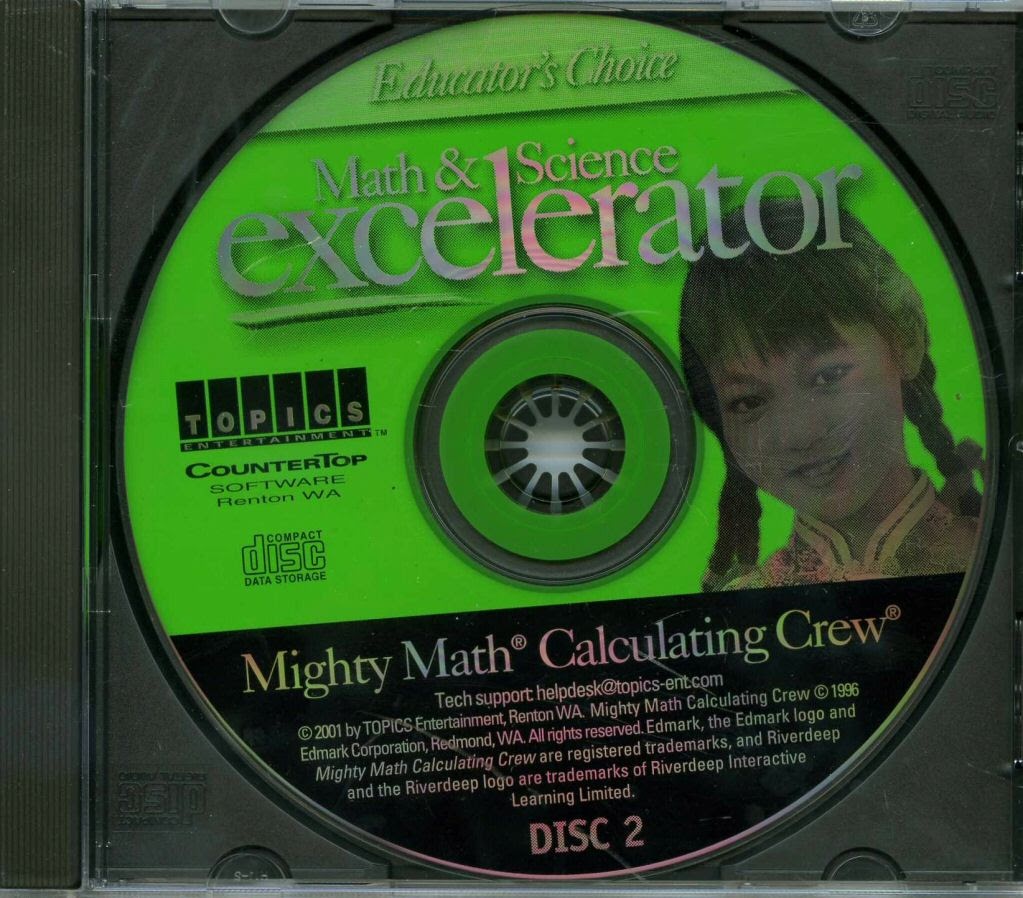
I am five years old, and my parents have bought me a PC game called Mighty Math Calculating Crew. As far as educational children’s games go, it’s a pretty standard one. The titular Crew (gender- and racially diverse in that nineties way that gestures optimistically towards a utopic future) is made up of five people: two natural disaster-stopping superheroes, a deep-sea diver, an astronaut, and a scientist who directs ‘the 3D lab’.
The game is recommended for children ages 8 to 12, but my parents are, as usual, trying to accelerate my learning. Much of the math is new to me and, though some of it is fairly straightforward, other areas are charged with an air of mystery. Long division, for example, is governed by organising logics that almost completely elude me. These are not hugely different from the organisational logics of the math I already know – they feel continuous, part of the same world – but their inner workings are nonetheless invisible to me. I can sense them distantly, interact with the numbers they govern, but I do not have a linear, tidy understanding of their rules. In this way, it is a lot like magic or poetry, with meaning living just beyond the limits of what our paradigms can touch.
I am immediately smitten, instantly hungry. I turn the difficulty up to the highest setting so that I can remain in the dark, sensing and bumbling, until I can come up with my own map of this world. There is something so beautiful about math, and I have been given a sudden intimacy with it. Math is clarity, but it is also a taste of the Sublime, a living network so much larger and more complex than my mind can ever fully grasp – I am lucky enough to learn this organically. Understanding is a thing that I can assemble pixel by pixel. So much of me begins here, in the security of this game, this relationship with seemingly omnipotent benevolence.
I return to the game over and over, getting a personal sense of long division, line graphs, and 2D nets of 3D shapes. I plant myself in front of the doorway of knowledge, soak in the light that emanates from it. I am math’s disciple. From here, everything in the universe is understandable if I am only patient enough to listen to it. From here, clarity is also opacity, and learning is also play.
Mighty Math Calculating Crew is a space I enter: physical and all-consuming despite its digital limitations. I wake up and come to rest here. Leave here and return. It is mine, not in the sense that it belongs to me, but in the sense that I am always welcome. Here, I am a self without filters. I get home from kindergarten and I return here. The word obsession does not capture the calm, the ease. For more than a year, my mind lives here part-time.
Within the four walls of our Windows 95 PC, it is safe for me to fail. I will not be responsible for knowing this math in school for another few years, so for now I am simply an explorer. It’s as if I’m wandering around in a forest, trying to get my lay of the land. I can only do this by walking around, coming to dead ends, tripping over rocks, falling into rivers. With each walk, the terrain becomes more familiar, and the working knowledge I gain starts to feel more valuable than any map. Because I have been here before, over and over, I know firsthand why I shouldn’t turn this way, why that way feels more promising. I know shortcuts and scenic routes, and understand that there can be multiple paths to the same destination. There is something alive about the way I begin to know the forest: pulsing, shifting, intimate. This process of searching, I find, is sweeter than the knowledge it brings me.
There is an order to this world, but it is playful, mystical. Fluid. The knowledge I build is somatic. A part of me, somewhere beneath analytical consciousness, learns to navigate the mathematical landscape, and the analytical, ‘rational’ part of my brain learns to trust this other part of me. There is so much beauty in what I cannot clearly name. There is so much beauty in getting to know math as a thing still with a life force, a spirit. I am in the dark, and the dark is fecund. The dark is lovely. I find a central piece of myself in the world of this game. I have the sense of myself, long before I can articulate it or consciously name it, as being an unknown. I am the dark, both in phenotypical relation to my classmates and in the sense that I represent something we don’t understand and are therefore afraid of. Math makes darkness feel beautiful. Math does not need to be fully understood in order to be loved, so there is hope for me.
The Lake Tahoe private school where I attend preschool through third grade has made an exception for me to be here. They usually don’t give financial aid scholarship, but they want me enough to do what it takes to get me. They give me a test before I start preschool, and I demonstrate remarkable aptitude. As an unknown, I am full of potential. Anything can come out of the darkness, and this is as exciting as it is scary. Once they have tested me, I am a risk worth taking.
Edouard Glissant says that our opacity is what makes us human, that the ideal state of Relation to another being (or a community of beings) is one where the only stable thing is instability. A community in Relation is always in flux, willing to be changed by Otherness even as it changes that Otherness in turn. For a community in Relation, not even language is fixed, existing perpetually as a Creole whose vocabulary and structures shift to accommodate the changing needs of a changing population. The centre of this is in the allowance of opacity, where the Self does not try to render the Other transparent on its terms but instead opens a space for the Other’s human contradictions and ambivalences, even if those contradictions and ambivalences don’t match the Self ’s, even if this means that the Other never becomes fully legible to them. Seeing and looking are presented here as conversations, involving an element of listening. In Relation, the Other is an infinity we refrain from making finite. In Relation, love is not predicated on legibility.
Mathematical aptitude is considered a shorthand for intelligence, and I find this out quickly. There are stakes to my failure – namely questions of my worthiness to remain in the spaces I’m in – but I become enamoured with the positives. If I stay good at this thing I love, I can justify my place. One of my classmates is the child of a Beach Boy, another the child of a Fortune 500 CEO, and another, when I visit their house, has an elevator. Whether or not I can articulate it, I am conspicuous here. The only Black student in my grade, and the only one receiving the kind of aid I receive. I am aware that my security here hinges on becoming solid; not dark, not opaque, not comfortably fluid. Math gives me weight, pins me down somewhere they can measure. If I’m good at math, I’m legible. When my younger brother starts at this school, I teach him his times tables, make him practise repeating products. Sometimes I call him over to my table at lunch and test him in front of my friends, show them that he’s solid, too. He loves math like I do, has a similar natural aptitude, and I nurture this. This will ferry him through the world if he lets it.
After I finish third grade, we move to a new city in a new state: Albuquerque, New Mexico. Quickly we find that there is a major private middle-high school in this city, ranked one of the best in the country, and soon I am trying to get in for sixth grade. They have summer programmes, and I enrol in one of those after fourth grade, to show interest. In those two years, I am at an Albuquerque public school, and we work to get me tested for the gifted and talented programme, because this will look good on my application. When I get in and go to take the tour, an admissions officer tells me I had one of the highest scores in my class on the math portion of the entrance exam, and I hold onto this like a source of definition.
Glissant writes that in their relationship with racialised Others, white Western powers (and individuals) become intent on reducing this other to the transparency experienced by oneself. Either the other is assimilated, or else it is annihilated. The Self is afraid of the Other, and the Western Self is on a quest to know the Other like it knows butterflies pinned to corkboards: through a kind of mastery, a domination. This Other, who knows themself to be complex and contradictory, is reduced by the Western Self to one or two dimensions. The perspective of the Western Self is backed up by power – physical military strength but also social and academic and institutional power – so this transparency is written over the Other’s natural opacity. The Other must, in turn, understand themselves as the Self understands them. They must learn to see themselves as the Other, not as a Self in their own right. Their safety depends on this double sight, their subjective Self Othered into object.
For many years, though, math is so much more than a means of social safety. While one part of me is playing the survival game, another exists in fullness inside the mathematical world. Inside the math classroom, in the textbooks and the problem sets, I am not thinking about fullness; I am simply full. What constraint exists in my life outside is gone, and I move freely inside mathematical logic as if it is second nature.
When I reach geometry, I luxuriate in the headspace of proofs. Initially, these seem limiting and prescriptive – and I baulk at them – with only one right way to get where we’re going, but soon I begin to feel like the logic of proofs is gentle. Yes, there is one accepted method, but I am able to find sense-making along the way, so when I arrive at the answer I understand completely why I have needed to do it the way I’ve done it. And once I have this, other paths sometimes make themselves visible – these are longer or alternative but no less correct. I want to call this a clarity, but it is a clarity I feel I have been allowed to find my own way to, such that I am changed by each proof. Even if they seem fixed before I start and after I finish them, they feel open during the actual process of solving. Here, freedom is able to exist within constraint. Here, I feel safe enough that it doesn’t need to be one or the other, and both can structure their own parts of the same experience.
There is also a period of years where I want to be, in the way that children covet professions they like the sound of, a cryptologist. In my mind, a cryptologist spends their whole life clarifying, taking in the world’s complex codes and outputting sense. I see them as translators, masters of legibility. I have begun to sense that there are things hidden behind the patterns and structures of the world, things that I can feel but not name. There are reasons for everything, but so many of these reasons elude me. My body itself is a subtext I am not taught to read, a variable that changes the outcome of any social equation in ways I don’t automatically know how to predict. I want to make a career out of pattern-reading because I want to grow up and be better at pattern-reading. This is, it feels like, a natural future for someone who loves and excels at math.
This willingness continually to revise one’s own location in order to place oneself in the path of beauty is the basic impulse underlying education. In On Beauty and Being Just, Elaine Scarry argues that universities and other institutions of learning are primarily concerned with beauty, with knowledge as beauty. Through learning, we are changed by something outside of ourselves, revising our own position in r/Relation to it. When this is chosen, enjoyed, we are enjoying it because it is momentous to be moved by something beautiful, by something o/Other than ourselves. Beauty here is something we are moved to learn about, but that we can never quite confine to understanding. Beauty is bigger than any container we could hold it in, and we know this. We are best off reaching out to touch it, being changed by the sensation it leaves on our skin, instead of trying to capture it, and we know this.
In seventh grade science, we draw our own calendars, with a different bug headlining each month, and though I am often frustrated by drawing, I enjoy this greatly. My teacher is excited about entomology, and he shares this excitement with us. There is a particular beauty to insects, one we are not often encouraged to notice, and we – young, eager – pour ourselves into the opportunity to consider this beauty that has newly been brought to our attention. Though it is just a homework assignment, most of the class takes incredible care in accurately depicting each of our twelve bugs. We linger on antennae, erase and redraw the curves of wings and abdomens, spend days trying to get the eyes right. When we turn them in, we are proud of what we’ve made, what we’ve learned in the process of making.
Soon math becomes heavily tied to its utility. I have been trying to balance means and ends, but the ends are getting louder and more urgent. It is hard for me to keep up and assert my place at the school, harder still to imagine my viability in college applications, and I begin to stretch the limits of its protection. Considered in the light of all the other students, all the other future applicants to the nation’s top colleges, I am suddenly found wanting. I have been afraid of reduction, and the necessary reduction that occurs in applying to colleges has a particular potency for people like me. When I am reduced, this reduction becomes all that will speak of me, all anyone is interested in seeing of me. I will need to present my aptitude, my skills, my trauma, my personality, and if I do it wrong there will not be the same benefit of the doubt that there is for white students. I understand this gaze; it is judgemental, eviscerating. It is as if someone comes into my darkness and shines a torch into every corner, such that no part of me can hide. Nothing about me looks good in this light; it makes me shallow, overwrites my depth. I know what is coming for me, and I am afraid. I throw math between myself and this, hoping it will shield me.
In the 1973 film The Paper Chase, a young, earnest student in his first year at Harvard Law encounters an infamously cruel professor named Kingsfield. His class is a rite of passage. He is no-nonsense, dedicated above all to the pursuit of excellence. This is why he does not tolerate ineptitude. His students are expected to have done the reading carefully, looking between the lines of cases in order to get at the underlying patterns, the beautiful logic of contracts. He is smart, accomplished, and he wants his students to meet him on his level. While most other students are frustrated by this, James Hart, our academic knight-in-training, becomes fascinated by Kingsfield. He reads all of Kingsfield’s publications, begins dating Kingsfield’s daughter, tries to get inside the way that Kingsfield thinks and sees the world. Hart has the sense that, underneath all the cruelty, Kingsfield’s relationship to law is an earnest one, predicated not on dominating mastery but on intimacy. Hart wants to grow into this kind of relationship – to know law like a lover’s body in the dark.
Hart has a classmate, Brooks, who has a photographic memory. Brooks is married to the daughter of a well-to-do family, but he himself comes from a lower-class background. While Hart is in law school for the love of law, Brooks is there so he can get the kind of job that would be acceptable to his wife’s family. Brooks’s success or failure has huge stakes. He needs this, desperately. But to Kingsfield, Brooks is looking for the wrong thing. A photographic memory is of absolutely no use to you, Mr Brooks, without the ability to analyse that vast mass of facts between your ears. It is below them to be looking for details; Brooks needs to be able to look behind the details, into the deep structure details don’t quite reach. But there is too much on the line to risk this.
With so much at stake, I think about utility. My objective in any class is not to learn as much as I can, but to get the best grade. This is a subtle yet crucial difference. The goal becomes not learning but the demonstration of learning, which really means convincing the teachers that I’ve learned. Everything becomes about optimisation. How low of a grade I can afford in one class so that I can steal time to bring up my grade in another class. How little I can study and still get an A, so I can try to sleep more than four or five hours a night. I need to do everything in my power to get myself into a good college. I need to carry everything I can bear. I begin to take the hardest classes I can manage, exploit any natural interest as motivation, dangle enjoyment in front of myself like a carrot.
My eighth-grade four-year plan for my math curriculum culminates in our school’s Logic class. I will take a summer course and a placement test to jump ahead to Trig/Pre-Calc freshman year, AP Calc BC sophomore year, our school’s special college-level Enhanced Multivariable Calculus class junior year, and then Logic my senior year. Logic, I believe, will put me back in the centre of math’s beauty, return me to it after the sacrifices I’m making for college applications. Logic is math’s rhythm transposed onto the world, a special sort of universe for philosophical and mathematical enquiry into the nature of things. Logic is a structure built outwards into darkness, each piece holding up the next. I want to know the world the way logic will help me know it, with a stripped-back sort of intimacy. It’s structure, yes, but it’s structure that’s conscious of itself as limited. A skeleton that never purports to speak for the flesh around it; only to give us an insight into the way that flesh moves.
I have sacrificed some of the play involved in my relationship with math, but it has mostly remained beautiful and intimate. I am enamoured, for example, with the way math treats irrational and imaginary numbers, how it deals with infinity. There are placeholders for each of these. Irrational numbers, numbers that cannot be expressed as the ratio between two integers, leave room for an endless flux. There are shades here of the Heraclitus proverb: we never step in the same river twice because (as a function of time) we are not the same selves, and neither is the river. Irrational numbers extend into the infinite – they are neither tidy nor truly capable of summary – and still we hold a place for them in our mathematics. The Golden Ratio folds forever in on itself, and we recognise this as beautiful. When we deal with imaginary numbers or with infinity, we have the placeholders i and ∞, which allow us to work with them without seeking to truly replace them. To use i is to accept that there are numbers that exist beyond the boundaries of our material reality’s ability to completely represent them. To use ∞ is to acknowledge the existence of the infinite within the finite. We work with them, accommodate them, even as we get about our business of calculation. In math, that which eludes our grasp, which chooses to remain opaque, we treat with reverence. I feel that Logic will take me to the heart of this, right into the bloodstream of math.
Logic, at our school, is taught by an infamous teacher, Dr Vraspir. People are afraid of him, but there is always some amount of respect in their fear. He’s notoriously tough, but this toughness is backed up by results and evident care for the subject. So when I end up sophomore year with Vraspir as my teacher for Calculus BC, I’m excited. I want Vraspir to see how much I love math, to recognise something of himself in me. At fifteen, I am becoming aware that my agency in this space as a Black body is limited. I cannot get angry, cannot even make any facial expressions someone might read as angry. I can’t move too quickly, too enthusiastically, or someone might flinch. I need the help and direction of people with more power in the space, need them to act on my behalf. Any action I take has the risk of being read as aggressive (or greedy, or not knowing my place, or inappropriate). Beyond this, I am petrified about my future, feel this overwhelming sense of doom, and I desperately want someone to guide me. So much is at stake, and I don’t believe in myself the way I used to.
Though I had sailed through Trig/Pre-Calc, I encounter immediate difficulty in grasping calculus. I have never had to work hard for math, but I suddenly find myself dedicating most of my homework time, as well as time on weekends or free periods or even passing periods, to calculus. Vraspir spends most of class time proving theorems, showing us why the rules are how they are. I would enjoy this, only I am stuck on utility; I don’t understand how to use the rules to do the homework problems, and I need to get this before I’ll be able to appreciate Vraspir’s acrobatics.
For reasons unknown, he takes an almost immediate dislike to me. I may be wrong, but I remember it starting even before our first test, with a sarcastic response to a question I ask in class. Maybe he thinks I’m not earning my keep as a sophomore in his class, which is populated otherwise by juniors and seniors, plus one genius seventh-grader, a freshman, and another sophomore. Only four of us are younger, and of them I am perhaps the least universally recognised among peers for my math ability. Vraspir takes pride in how serious his class is, and maybe he thinks I undermine that. That I am not worthy to be here a year early. Maybe my Blackness has something to do with it as well; if a Black sophomore can get into his class, which he runs like a college lecture, maybe this appears like a threat. Maybe it’s a now they’re letting anyone in here thing. I’ll never know. All I know is that he’s meaner to me than any teacher has ever been, in a way that feels personal, like he takes some pleasure in it.
Early on – now after the first test, which I don’t do great on – I remember building up the courage to go in to his office hours and ask about the homework problem set. I tell myself that he’s not necessarily mean, that it isn’t personal, and maybe I just got the wrong impression. Even if he doesn’t like me, maybe this can change that. I cannot be more wrong. He is immediately terse, answering the questions I’ve spent the past day figuring out how to compose with frustrated non-answers. Well, did you read the chapter? It’s all right there in the book. I don’t understand why you don’t get this; it’s simple. I ask him to walk me through the steps of solving one of the problems, and he refuses. Maybe if you didn’t sit in the back with the slackers, you’d do better in my class. I leave in tears.
Towards the end of the term, exhausted from trying to understand the things he won’t help me with, I fall asleep in his class and he publicly humiliates me for it. And you wonder why you’re not doing well in this class. Maybe if you cared to pay attention, you wouldn’t need to come by during office hours. I have discovered by this point that the proofs he does all lecture are partially him showing off, showcasing his mastery over his discipline and his students, but I do not say this. When my parents came back from parent–teacher night, they said that they’d never encountered someone so condescending and superior – that he spent his whole talk bragging about himself and said nothing about the content of his class – but I do not say anything. I lose all respect for him. To truly hate someone, you need to stop believing in their capacity for humanity, and I have come to hate him.
At the very end of the first term, we need to submit our schedules for the next school year, get each of our current teachers to sign off on the next class in each subject. When I go to Vraspir, propose to take Enhanced Multivariable Calculus next year, he tells me no. I should drop down to Calculus AB for the next term, then retake Calculus BC next year. Emboldened with an uncharacteristic brashness, I ask if he’s going to be the only teacher teaching Calc BC next year, like he is this year. He tells me yes. And I say, Well then, no. You’re going to sign this, because I never want to have to take another class from you again. I know that I am not exaggerating Vraspir’s cruelty, because of how I respond here. Only fifteen, I have never been as rude to an adult as I am in this moment. At this age, the claws never come out unless my back is against the wall, unless all other options have been exhausted.
In The Paper Chase, Professor Kingsfield is looking for successors in his academic lineage. Like all subjective forms of grading, his is an evaluation of how closely a student fits his desired profile. Like all subjective forms of grading, his is a way to separate the chaff from the wheat. Hart, earnest to a fault, interested in the purity of law – but also white, (at least) middle-class, male, able to enter the space of Harvard Law as an unmarked body, without external life concerns finding their way into the sacred space of study – is his ideal successor. He is tough on Hart, but he throws him a few bones none of the other students get, and he gives him an A- on his final essay. Brooks, however, is followed into the classroom by his class precarity. He does not have the privilege of separating this education from its utility, and he is punished for this. While Hart finishes the year a step closer to academic enlightenment, Brooks tries to kill himself and then drops out.
Beauty is the story that academia tells about itself. Knowledge, it says, is a calling, and the institutions that give material form to this calling are free from everything but earnest pursuit. There is no power here, only the comforting, intimate darkness I found in math as a child. This is the only agenda. But there is always a process of choosing who is worthy to carry this torch, synonymous with a process of excising the bodies deemed unworthy. In the story academia tells, these biases and abuses of power are beside the point, but what if they’re actually central to the project? What if all of it is about worthiness and who is entitled to bestow it?
When Vraspir decides that my interest in understanding is not enough for him to help me understand, it feels like he is math’s literal gatekeeper closing me out. I am not the right kind of student for him, for whatever reason, and he acts on this judgement, works to make me feel unwelcome. This changes my relationship to math for ever. After hitting a wall with Vraspir, I seek help from another teacher, Mr Smith, who is generous enough to take time out of his morning twice a week to tutor me before school. I do okay in the class, then quite well in Multivar. But there is something that has been shattered in me. Vraspir’s cruelty feels personal, subjective, and math classrooms have heretofore been the only space free of that. I have come to know that my Blackness is often a losing bid when it comes to a teacher’s subjective appraisal. My luck in English classrooms is back and forth, and the same is true for history and band. But math has never been a space where the teacher is a factor. Math has always been between me and the subject itself. It is not just that Vraspir stands between me and math; it is also the shock of realising that someone can stand between us, that my idealised trust in math might be wrong. My suitability for math can be decided subjectively, just like anything else. Math cannot ferry me through anything. Math will not always save me.
I also understand now, as I did not then, that there is not as clear a line between adult and child as I may have wanted to believe. Adults regularly behave as recklessly and immaturely as children do. For many years, I thought every child’s maturity was under the same pressure and scrutiny mine was, that the standards I was being held to were consistent across the board. My emotional expression was policed and pathologised in the white spaces I came of age in, and I believed for so many years that I was failing to develop the way a person was supposed to. I was sensitive and selfish and inconsiderate, but I believed that this qualified me as an exceptionally bad and immature person. I was held accountable for more slip-ups than other students, so it baffled me when adults – who were supposed to have already met these maturity standards long ago – could treat me like shit and get away with it. Worse was the dawning understanding no one was rushing to defend me when adults acted out, that if I didn’t believe I deserved unkindness I would be breaking from consensus (and therefore on the other side of something). When Vraspir crossed the line into personal attack with the ‘slacker’ comment (especially because, to me, it was so obvious that it wasn’t true), a crack opened up in the centre of my world. Vraspir was so openly cruel in a way I could no longer convince myself I deserved. How could he mis-see so sharply? What was he projecting onto me? Later, when I tried to tell the head of the math department about the ‘slacker’ comment, he said, Maybe he was just having a bad day? and shamed me for wasting his time. Though I’d had bad experiences with teachers before, this – shattering as it did the beauty and safety of math – was when I lost the last vestiges of my childhood innocence, when I stopped trying to look away.
When I complain later about this horrible man and his superiority complex, my parents will suggest that he felt threatened by me, that he interpreted my very presence in the class as a challenge. He had lived past his glory days of being the young math star, and now he was picking fights with people who thought they could ascend to the place he used to fill. By being in his class earlier than I should have been, I was making a bid for this, and his job changed from teaching me to putting me in my place. No matter how ineffective I was at actually playing this role, he saw me as an opponent rather than a student. I don’t disagree necessarily, but what always struck me was that he seemed to like the other younger students; they were among his favourites in the class. It is hard for me to get over the fact that it feels like I never had the chance to be liked by him, that there was something particularly wrong about me to him, some evident unworthiness.
As the years go by and I get less bitter about the experience, I believe that Vraspir saw something in me that scared him. Not a threat but a kind of rawness. Scared as I was of being caught out in this institution where I was hyperaware of my status as an exception, a guest, I lived on a knife’s edge and I operated at the upper limit of my abilities. I was a tightrope-walker teetering over a great chasm, and I think he saw me looking down. There was something desperate and animal and brittle in me, and I think he saw this and wanted to cast it as far from him as possible. Some people, no matter their age, react to weakness with cruelty. At that point, I needed math; it was the pole I used for balance on the tightrope. In those first few weeks when I didn’t understand the math, it felt like I would never understand again. I must have looked like one of those drowning people who flails so much that they risk the life of any rescuer. He must have hated this desperation, been repulsed by it. I needed to understand, I believed, or I would fall. It was as simple as that. I had always known there would be a fall – simple probability told me so, and I was used to hearing that the odds were against people like me – and maybe it had finally come. When I took as long as I did to get calculus, it was as if an entire world had closed its doors on me, as if I had fallen from dimensional, robust darkness into harsh, reductive light.